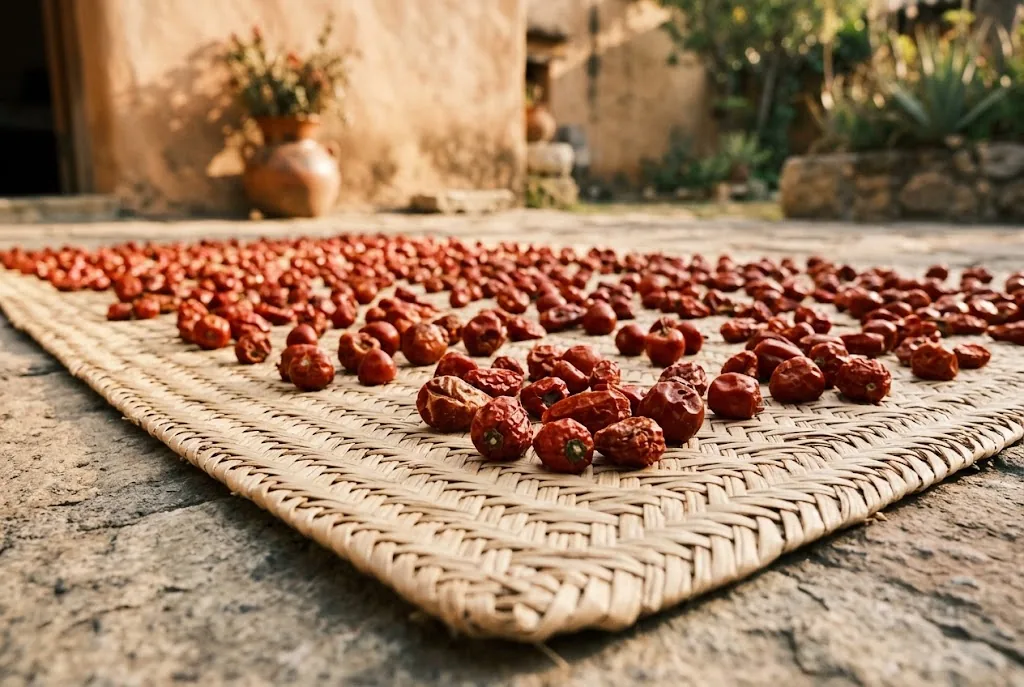
Chili peppers began as American plants and became indispensable ingredients far beyond their original range. Their story starts with wild pepper plants, early cultivation, and food traditions that developed before European contact. For a broader introduction to the plants, their heat, and their uses, see the complete guide to chili peppers.
Where peppers began
The pepper genus is in the nightshade family, alongside tomatoes, potatoes, and eggplants. Its wild species are native to the New World, with important centers of diversity in Central and South America. The cultivated peppers familiar today did not come from one single domestication event or one single place. Botanical and archaeological research describes five independently domesticated species: C. annuum, C. chinense, C. frutescens, C. baccatum, and C. pubescens. A modern monograph of wild and cultivated peppers traces those separate histories across the hemisphere.
That distinction matters when telling a chili history. C. annuum includes jalapeños, mild types, bells, and many other peppers, but it is only one of the five cultivated species. Other lineages have their own geographic histories, flavors, and growing conditions. Our guide to the five domesticated chili species explains how those groups differ.
Mexico and C. annuum
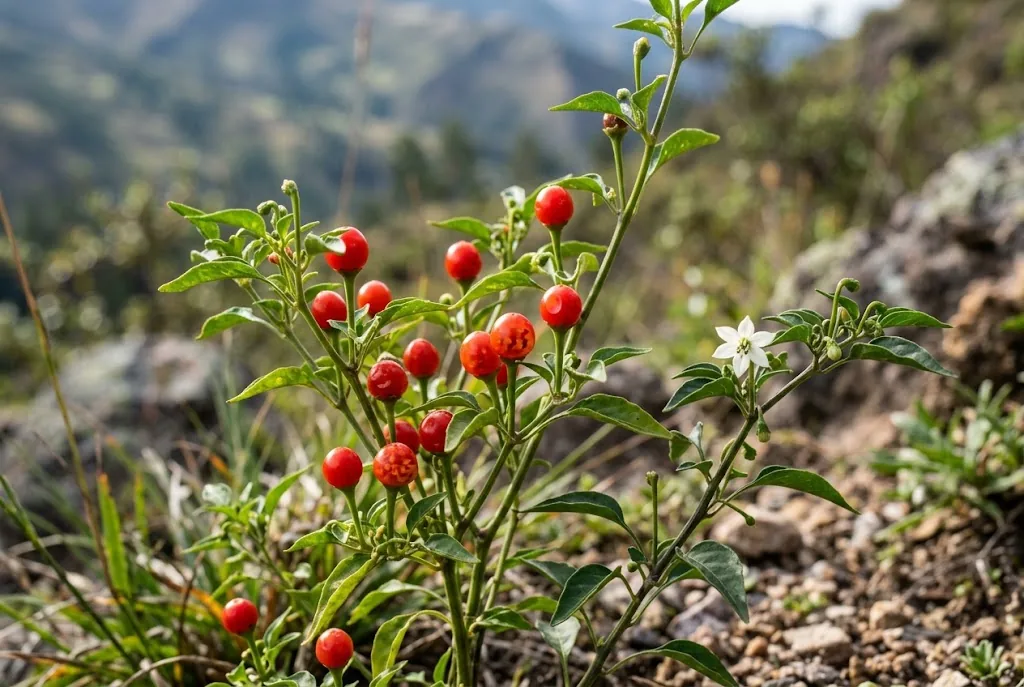
Evidence points to Mexico as the center where C. annuum became a cultivated crop. Its likely wild progenitor, often called chiltepin or C. annuum var. glabriusculum, bears small, erect fruits and occurs across parts of Mexico and Central America. Genetic, ecological, linguistic, and archaeological evidence supports a Mexican origin for domesticated C. annuum, although researchers still debate the most precise region within Mexico. Kraft and colleagues’ study of C. annuum origins sets out both the evidence and those limits.
Archaeological remains from the Tehuacán Valley show that people were closely interacting with chili peppers about 6,000 years ago. Those finds are important, but they do not make every early fragment definitive proof of a fully cultivated form. A careful account should separate evidence of use, cultivation, and fully developed cultivation. The archaeological review of chili use in Chiapas summarizes evidence from Tehuacán, Guilá Naquitz, Ecuador, and Peru, including the uncertainty that remains around some early materials.
Early American food traditions
Chilies were valued for flavor and versatility. They could be eaten fresh, dried for later use, crushed, or worked into sauces alongside staples such as maize and beans. Archaeological starch and residue studies show that people processed peppers in many regions, while preserved fruits and seeds help show how particular species moved through local food systems.
In Mesoamerica, chilies became part of everyday cooking as well as trade and ceremonial life. It is more accurate to discuss the Maya and later Mexica or Aztec societies separately than to call them one “classical era.” Their histories overlap in the long development of Mesoamerican foodways, but they belong to different periods. Historical sources and archaeological evidence can illuminate particular uses, yet broad claims about health effects, household fumigation, or discipline should not be made without a source that directly supports them.
Why several pepper species matter
Each cultivated species reflects selection by growers in different environments. C. annuum became the most widely grown species worldwide, but the other domesticated peppers are not minor footnotes. C. baccatum includes many ají types associated with South America, C. pubescens is known for its dark seeds and hairy leaves, and C. chinense and C. frutescens include many influential hot peppers. The differences are the result of long agricultural histories, not simply modern naming.
That diversity also explains why “chili pepper” is a useful kitchen term but an imprecise botanical one. A popular pepper, a rocoto, and an ají can all be hot peppers while belonging to different species or growing traditions. Starting with the species makes the history clearer and prevents a single Mexican story from standing in for the whole hemisphere.
What the archaeological record shows
The record is scattered because peppers do not always preserve as clearly as stone, bone, or pottery. Even so, it shows long engagement with peppers in several regions. The review reports plant remains associated with human settlements on the northern Andean coast from about 8000 BCE and evidence that C. baccatum, C. chinense, and C. frutescens were cultivated or consumed along the Andes by roughly 4000 to 4500 BCE. Those dates describe early evidence, not a single moment when every pepper became a crop.
Mexico supplies a different but equally important part of the history of chili peppers. The Tehuacán Valley and other sites preserve evidence relevant to C. annuum, while microfossils from food-processing tools help show how people used peppers with other crops. The archaeological record supports a long process of gathering, tending, cultivation, and selection. It is better to describe that process than to turn one excavation into a simple origin story.
Selection changed the fruit and the food
Wild chili forms and domesticated chili peppers are not interchangeable. Growers could favor plants with fruits that were easier to harvest, more substantial, or suited to a particular flavor and heat. Over generations, those choices produced different peppers for different cuisines and landscapes. The result was not one generic hot pepper, but a family of species and cultivars with distinct histories.
The term Capsicum helps keep the botany clear. It covers a genus, while words such as chili, chile, and chilli are common culinary names that vary by region and language. A bell pepper, cayenne pepper, poblano, and jalapeño may all appear in the same kitchen conversation, yet their history depends on the species, cultivar, and place being discussed.
Wild pepper plants and cultivated forms
The wild ancestor most often discussed for C. annuum is a small-fruited pepper sometimes called chiltepin. It is not a miniature garden pepper. Wild fruits are typically much smaller, and domesticated forms reflect human selection over many generations. The distinction is useful when reading about early pepper plants because archaeological remains may show use of a pepper without identifying whether people had already produced a fully domesticated variety.
Researchers combine several kinds of evidence to investigate that question. Genetics can show relationships among plants. Ecological models can identify landscapes suitable for wild relatives. Archaeology can date plant remains and food-processing traces. Historical linguistics can show that communities had words for a crop. None of these methods answers every question on its own, but together they make the history more specific and more honest about what remains uncertain.
That evidence also counters an easy misconception. The Americas were not merely a launch point for one pepper that later diversified elsewhere. Different cultivated species were grown in different parts of Central and South America before their later global spread. Mexico is central to the history of C. annuum, while the Amazon, Andes, Bolivia, and other regions matter to their histories.
Peppers in American kitchens
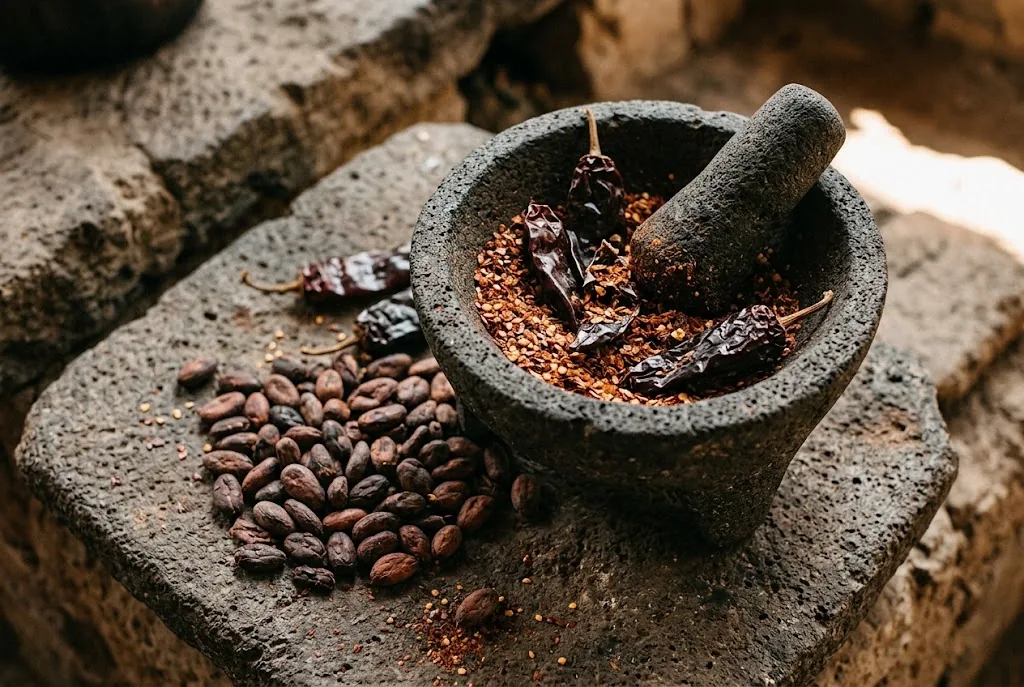
Fresh pods, dried peppers, sauces, and ground seasoning all have long roots in American food traditions. Drying made a harvest easier to store and transport, while grinding could turn peppers into pastes and seasonings. These practical uses help explain why these peppers worked so well beside maize, beans, squash, and other staples. A pepper could supply color, aroma, and heat in a small amount, while a larger harvest could be preserved for another season.
Regional naming is part of that history too. In US English, “chili” is common, while “chile” is often preferred in Mexico and the US Southwest. “Chilli” is standard in much of the English-speaking world outside North America. The spellings can signal place and tradition, but they do not change the underlying botany: the pepper group is a genus, and a precise species name matters when a historical claim concerns origin or cultivation.
Heat, birds, and wild chile dispersal
Capsaicin is the compound that gives many hot peppers their spicy heat. In pungent fruits, capsaicinoids are concentrated mainly in placental and septum tissues rather than in the seeds themselves. That chemistry is part of the plant’s ecological story. The source review reports that capsaicin can discourage mammalian seed predators while many birds are relatively insensitive to the heat. Birds can therefore eat ripe fruit and disperse seeds, whereas mammals often avoid it.
Not every pepper fruit is equally hot, and heat is not a reliable shortcut to species identity. A sweet pepper and a cayenne pepper can both be C. annuum, while a pepper’s local name may tell a culinary story rather than a botanical one. The history of chili peppers is consequently a history of both plant diversity and human selection. Growers chose useful traits, and cooks made different peppers meaningful in different cuisines.
Dates, evidence, and a careful history
Early dates need especially careful wording. Remains associated with people can show that a wild chile was gathered or processed; they may not prove cultivation. A larger fruit or a changed seed can point toward cultivation, but evidence must be read alongside the site, the dating method, and other crops found there. This is why scholars continue to refine the history rather than offering one final date and place for all peppers.
For C. annuum, the strongest account is a Mexican cultivation process beginning around 6,000 years ago, expressed as a process rather than a single event. For other cultivated peppers, the evidence points to independent histories in Central and South America. That shared American heritage matters more than a tidy story in which every chili, chile, or chilli came from the same valley.
The labels chili pepper, chile pepper, and chilli pepper reflect regional language as much as botany. In every cuisine, a writer should identify the particular pepper when the history depends on its species or cultivar. Communities learned to cultivate plants over long periods, rather than simply finding a finished crop ready to domesticate.
A foundation for later cuisines
Before the Columbian Exchange, these peppers already had deep roots in American agriculture and cooking. Their later movement to Africa and Asia did not create that foundation. It carried American crops into new food traditions, where growers and cooks made them their own. The story therefore begins with Indigenous knowledge, regional cultivation, and the careful work of people who recognized value in a small, pungent fruit.

From American crop to global ingredient
After 1492, Christopher Columbus and later Iberian traders helped carry peppers beyond their native range. The explorer’s comparison with black pepper was botanical shorthand, not an identification: black pepper comes from Piper nigrum, not the pepper genus discussed here. That later chapter transformed cuisines across Africa, Asia, and Europe, but it deserves its own treatment rather than a rushed ending here. Continue with how chili peppers spread around the world after 1492 to follow the Columbian Exchange and the crop’s global adoption.
The earlier history remains just as consequential. Long before these peppers reached every kitchen, Indigenous growers and cooks selected plants, preserved harvests, and built food traditions around them. The peppers now found in sauces, stews, and gardens around the world carry that much older American history.
