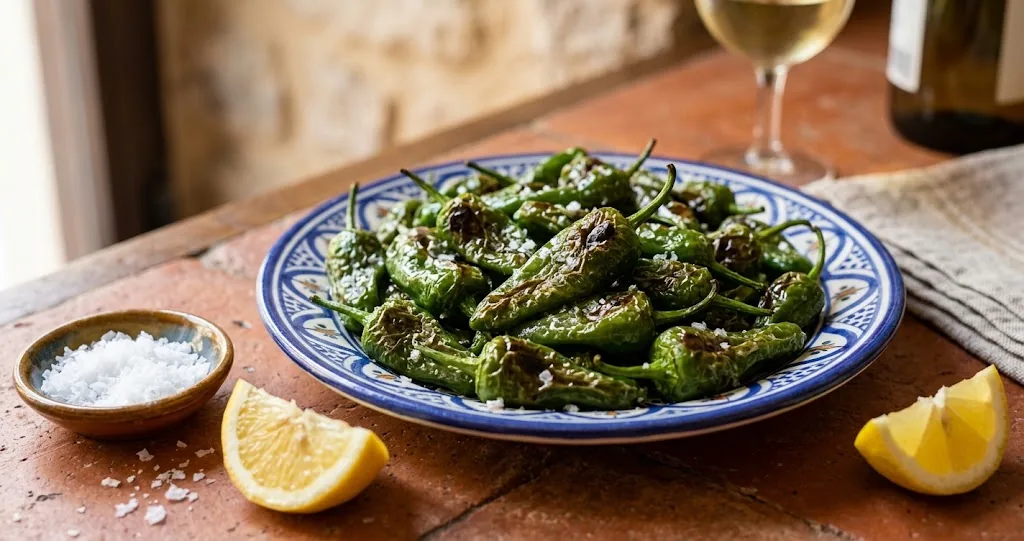
Padrón peppers are the small green peppers served blistered in olive oil and flaky sea salt as a classic Spanish tapa. Most are mild and grassy, but the odd pod turns up the heat without warning, which is exactly why this pepper has kept its place at the Galician table for over a century. They are a Capsicum annuum landrace from the municipality of Padrón in northwestern Spain, simple to grow, and ready to eat about 60 to 80 days after transplanting.
Origin and history: from Padrón to your plate
The Padrón pepper takes its name from the town of Padrón in the province of A Coruña, in Galicia. Local tradition credits Franciscan monks of the Herbón convent with bringing the original seed back from Mexico centuries ago, and the variety has been grown in this small corner of Spain ever since. Within Spain the same pimiento is also sold under the name Pemento de Herbón, after the nearby parish of Herbón where the original convent gardens sat. Pimientos de Padrón grown in that original area can carry the protected Indicación Geográfica Protegida (IGP) Pemento de Herbón label; the name Padrón itself is not the protected designation.
The plant is part of the broader story of how chili peppers spread from Mexico and Central America through the Spanish colonies and into European cooking after Columbus. The Galician growers who first received the seed selected pods for small size and thin walls, which made them ideal for quick frying in oil. From those early convent gardens the variety spread to home kitchens and small farms across northwestern Spain, and eventually across Spain and the wider Spanish-speaking world. By the late twentieth century the peppers had become a standard offering on tapas menus from Madrid to Barcelona, and they crossed into the United States in the 1990s as chefs like José Andrés and others began introducing Spanish small plates.
Spanish growers and chefs often use the phrase os pementos de Padrón, uns pican e outros non, which translates as “some are hot and some are not”. The saying is part recipe and part warning. Because the heat in any single pod is unpredictable, eating the peppers is a small game of culinary roulette, and that game is part of the appeal. Today the peppers are also a regular sight at the farmers market across the United States from late summer into early autumn, where they usually arrive under the name padron peppers.
If you want to understand how a mild Spanish pepper fits into the wider picture of chili varieties, the types of chili peppers guide covers the species and the heat ranges side by side.
Botany and pod: shape, size, color and skin
Padron peppers are a landrace of Capsicum annuum, the same species as bell peppers, jalapeños and cayenne. The pods are small and elongated, usually 3 to 6 cm long (about 1 to 2.5 in), with a slightly conical shape, a pointed tip and smooth, glossy skin. Left alone the pepper will ripen from green to a deep red, but they are nearly always picked young and green, the stage at which they are sold as the classic Spanish tapa.
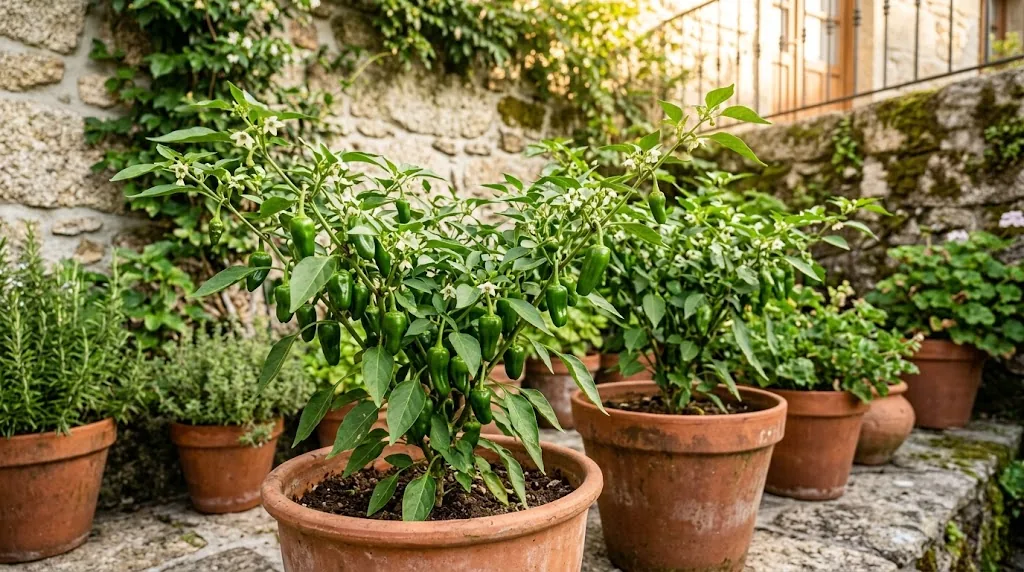
The plants are compact and bushy, typically reaching 50 to 90 cm (20 to 36 in) tall, with small white flowers and fruit that points upward or slightly outward as it develops. As with other Capsicum annuum peppers, the capsaicin is concentrated in the white pith and seeds rather than in the flesh itself, which is why a thin padron pepper can still bite when the seeds are scraped against the inner wall during cooking. The peppers’ bright green color and slightly waxy skin signal freshness; pods that look dull or have started to wrinkle have been off the plant too long and tend to be flabby when cooked.
Heat and flavor: why some are hot
Most Padron peppers land at the very low end of the heat scale, roughly 500 to 2,500 Scoville Heat Units (SHU). That places them well below a jalapeño (2,500 to 8,000 SHU) and far below a habanero. Their flavor is grassy, slightly nutty, with a mild bitter edge when raw and a sweeter, almost buttery quality once blistered in olive oil.
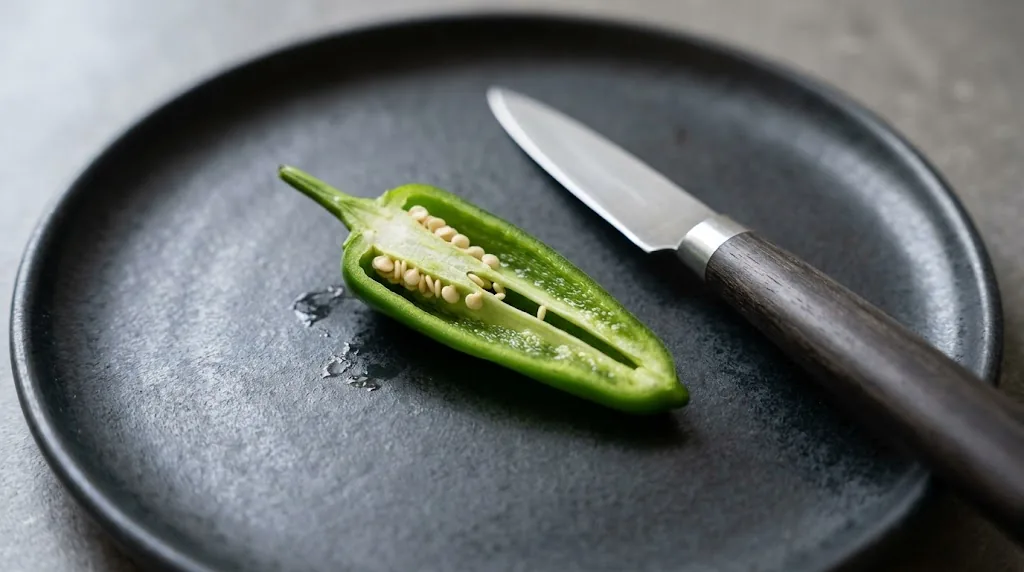
The surprise comes from a small percentage of pods that, for reasons that are not fully predictable, develop significantly more capsaicin. Stressed plants, hotter weather and more mature fruit all increase the odds of a fiery pod, but no visual cue reliably separates it from its mild siblings. Only a minority of pods run hot. Many cooks put it at around one in ten, though the real share varies by batch and season. The simplest answer to are padron peppers spicy? is “usually no, occasionally yes”. Drought-stressed plants and more mature pods both lean toward the hot end, and any pod left on the plant until it has turned from green toward red is more likely to bite.
Compared with shishito peppers, another small green frying pepper that has become common at farmers markets in North America, Padron peppers share the same “mostly mild, occasionally hot” character but tend to be slightly larger and more conical than the wrinkled, blunt-tipped shishito. Their heat range overlaps with shishito but the typical padron leans a touch warmer on average. If you already cook shishitos, padrons behave the same way in the pan.
How to grow Padron peppers from seed to plate
Padron peppers are grown essentially the same way as other small-fruited Capsicum annuum peppers. Start seeds indoors 8 to 10 weeks before your last expected frost. They germinate in 7 to 21 days at a steady 21 to 27 °C (70 to 80 °F) and prefer a light, well drained seed-starting mix. Bottom warmth from a heat mat speeds up germination and raises the overall germination rate.
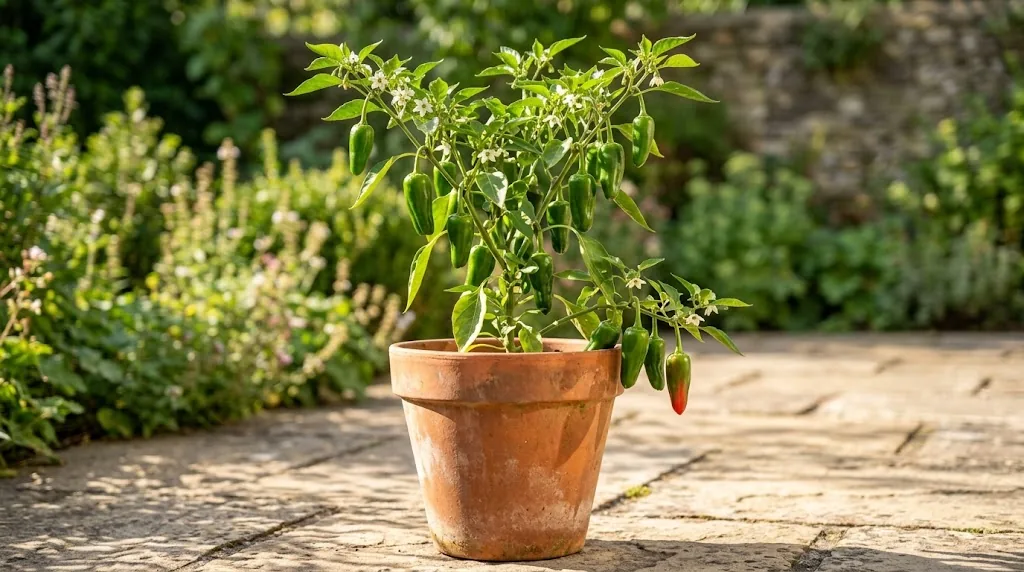
Transplant outdoors or into a large container once nights stay above about 12 °C (54 °F). One plant per 5 to 7 gallon pot works well; in beds, space plants about 45 to 60 cm (18 to 24 in) apart. They want full sun, consistent moisture and a soil that drains freely, with a pH between 6.0 and 7.0. A balanced organic fertilizer at planting, followed by a light feed every 3 to 4 weeks through flowering, is plenty. Avoid high-nitrogen feeds once the plants start to flower; too much nitrogen gives leafy growth at the expense of fruit set.
Most padron peppers are ready to pick 60 to 80 days after transplant. Pick pods young, while they are still glossy green, about 3 to 6 cm long. Picking regularly encourages more flowering and fruit set, so a well-tended plant will keep producing over a long window from mid-summer into early autumn. The pepper responds well to a steady supply of water; inconsistent moisture is the most common cause of blossom end rot. A 5 cm (2 in) straw mulch around the base of the plant helps keep soil moisture even and the lower pods off the soil.
Common problems mirror those of other peppers: aphids on new growth, spider mites in dry indoor conditions, blossom drop during heat spikes above 32 °C (90 °F), and blossom end rot if watering is uneven.
Harvesting and handling
Snip padron peppers with a small pair of snips or by snapping the stem above the calyx, leaving a short piece of stem attached. Picking in the morning, when pods are firm and cool, gives the best flavor and shelf life. Use a shallow basket rather than a deep bucket so the pods at the bottom do not bruise.
Most Padron peppers are mild enough to handle without gloves, but if a particularly hot pod shows up in the batch it is worth keeping nitrile gloves handy. Wash hands well after handling, and never touch your eyes or face while seeding or chopping a fresh batch. For seed saving, leave a few pods on the plant until they are fully red and slightly wrinkled, then scoop the seeds and dry them thoroughly before storage. Saved seed stays viable for 3 to 4 years if kept cool and dry.
Storing, drying and preserving
Fresh Padron peppers keep in the refrigerator for about a week when stored unwashed in a paper bag or loosely covered container. For longer storage, blister and salt them first, then refrigerate for 3 to 4 days, or freeze the raw whole pods on a sheet pan and bag them once solid; they will keep for 6 months and can be dropped straight into a hot pan from frozen.
Padron peppers can also be dried. Slice them in half lengthwise, lay them on a screen or in a dehydrator at 50 °C (125 °F) until leathery, then store in an airtight jar. They lose their bright grassy flavor when dried and become a deeper, slightly smoky cooking pepper, useful for soups, stews and bean dishes through winter. Pickling is another option: a quick refrigerator pickle of blistered pods in vinegar, garlic and bay keeps for about a month and turns the peppers a dull olive green that looks striking on a cheese board.
Culinary uses
The classic Padron peppers recipe could hardly be simpler. Heat a cast iron frying pan on the stovetop, add a generous pour of olive oil and wait until the hot olive oil is lightly smoking. Lay the peppers in a single layer and fry them for 2 to 3 minutes, turning once, until well blistered and tender-crisp. Tip the blistered padrón peppers onto a plate, sprinkle with coarse salt and serve immediately, straight from the pan. They are eaten with the fingers, stem and all, paired with cold beer or a young white wine. This is one of the mild chili peppers with big flavor that shows how little heat you really need, and it is also one of the most popular tapas served across Spain every summer.
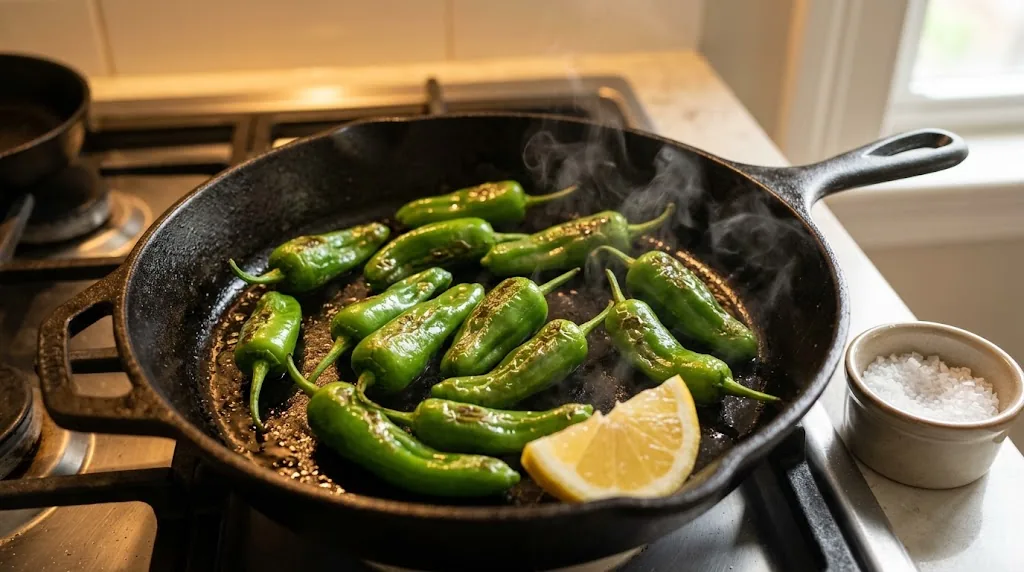
Beyond the tapa, Padron peppers work well in any recipe that calls for a small, mild green pepper. Toss them into stir fries, fold them into omelets, char them on the grill alongside meat and seafood, or pickle them for cheese boards. For home cooking they are forgiving, and a gardener with even one healthy plant will have enough for several rounds through late summer. They also pair naturally with garlic, lemon, smoked paprika, chorizo, sherry and sharp sheep milk cheeses such as manchego. For a fuller plate, serve the peppers alongside blistered cherry tomatoes, crusty bread and a wedge of aged cheese. The only substitution rule that matters: do not use a bell pepper in their place. The texture, the small size, and the bit of char are what make the dish. As an appetizer plate for friends, this is hard to beat: a bowl of blistered padron peppers, a wedge of manchego, and a glass of cold white wine.
Where to buy padron peppers and what to substitute
Padron peppers are a seasonal crop. In Spain the natural season runs from late June through September. In the United States the peak is mid to late summer, when they show up at farmers markets, specialty grocers and the better-stocked supermarkets, often sold in 8 oz (225 g) clamshells or loose by the pint. Out of season, frozen whole padron peppers are widely available and a perfectly good substitute for fresh ones, especially for the blistered tapa preparation.
If you cannot find padron peppers at all, the closest substitutes are shishito peppers (similar small green pepper, slightly blunter and more wrinkled), small mild Italian long peppers such as friggitello, or the youngest green jalapeños sliced into strips. None of these matches the precise sweet grassy flavor of a true Padrón, but each one takes the same blistered treatment and finishes with flaky sea salt for a very similar plate.
Padron peppers FAQ
Are padron peppers hot? Most are mild at around 500 to 2,500 SHU, but a minority of pods turn up the heat. The heat cannot be predicted from the outside of the pod.
Can you eat the seeds? Yes. The seeds carry a small amount of capsaicin, but most of the heat in any Padrón pepper lives in the white pith and placenta, not the seeds themselves.
How long do padron peppers keep? Fresh pods keep in the refrigerator for about a week. Blistered and salted they last 3 to 4 days. Frozen whole pods keep for 6 months or longer.
Do padron peppers get hotter as they ripen? Yes. Mature red pods run hotter than young green pods, and drought-stressed plants tend to produce hotter fruit.
