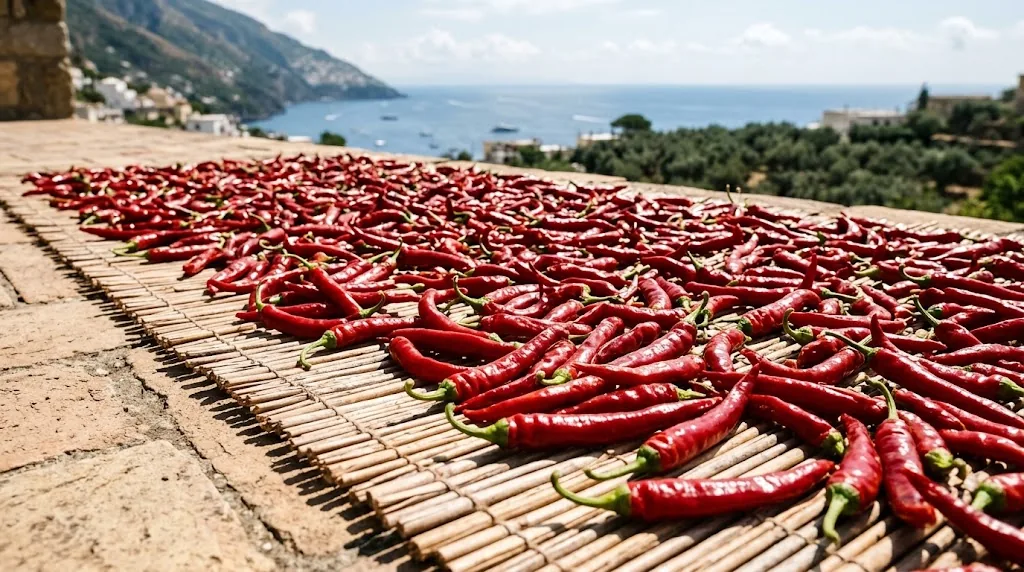
Chili peppers grew in the Americas long before Columbus crossed the Atlantic. After transatlantic contact, sailors, traders, and growers carried them into Europe, Africa, and Asia. By the seventeenth century, the crop had reached many regions now known for chili-rich food. Global exchange moved the plant, but local people chose how to grow it and cook with it.
For the plant’s American beginnings, see the separate history of chili peppers. This page follows the routes beyond its homeland and the evidence behind the best-known dates.
A quick timeline of the chili pepper’s spread
| Date | Place | What the record shows |
|---|---|---|
| 1494 | Caribbean and Spain | Diego Álvarez Chanca wrote about the spice used in Hispaniola after a Spanish voyage. |
| 1510 | Western India | Portugal captured its main west-coast port, which became the capital of Portuguese India in 1530. |
| 1511 | Malacca | Portugal captured the port, strengthening a trade network. This is not a documented arrival date for chilies. |
| 1542 | Europe | Leonhart Fuchs published illustrated peppers under names that suggested an Indian origin. |
| 1565 onward | Mexico and the Philippines | The Manila galleon route linked Acapulco with the Philippines and carried American plants across the Pacific. |
| 1614 | Korea | A commonly cited early written reference appears in Yi Su-gwang’s Jibong Yuseol. |
A port’s conquest or a trade route’s opening is evidence of a possible path, not proof that the first chili arrived that year. Some routes remain debated. Historical documents, plant illustrations, and modern genetic studies together give a better picture than one neat origin story.

Domestication before the Atlantic voyages
Indigenous growers had already developed Capsicum crops in their homeland. That domestication produced five cultivated species: Capsicum annuum, C. chinense, C. frutescens, C. baccatum, and C. pubescens; bell peppers and cayenne belong to the first. European voyagers encountered a plant with a kind of heat they compared to black pepper, although the two are unrelated. In a 1494 letter, physician Diego Álvarez Chanca described the seasoning used on Hispaniola. He is often credited with carrying seeds to Spain, but the surviving letter establishes observation more clearly than the exact journey of any seed packet.
Chilies could grow in many warm regions and supplied spicy heat without importing Asian peppercorns. That helped them spread, but it does not mean they simply replaced older spices. Research on the early modern spice trade finds that peppercorn commerce remained strong after chilies arrived. Local cuisine changed gradually and differently from place to place.
The plants also drew attention as curiosities. In 1542, German botanist Leonhart Fuchs illustrated several chili peppers and attached names suggesting India or Calicut. The labels show how quickly the crop circulated and how easily European writers confused its route with its American origin. The chile pepper had crossed oceans, but its botanical homeland had not changed. For an overview of the plant and its uses, see the complete guide to chili peppers.
The names tell part of that story. Spanish writers used a word related to pimiento, while chile came from Nahuatl. Calling the American crop a pepper reflected its heat, not a relationship to the Asian pepper plant. Those overlapping names still make early trade records hard to read without context.

How chili peppers spread through Africa and India
Portuguese ships connected Brazil and Atlantic Africa with ports around the Indian Ocean. These routes help explain how American peppers reached Africa and Asia, while local merchants and farmers carried them onward. Portugal captured Goa in 1510, and the city became the colonial capital in 1530. The dates describe colonial control, not a precisely recorded first chili harvest.
In Africa, coastal trade linked American plants with settlements around the Gulf of Guinea and the southeastern coast. Later exchanges moved varieties inland and through West and Central Africa. Historians and genetic research both point to multiple paths, including Atlantic trade and later movement among African regions. The piri-piri name, closely associated with small hot peppers and sauces in Mozambique, is one reminder that African cooks made the crop their own. Its precise linguistic path is debated.

From India, maritime networks connected growers and traders with Southeast Asia. Portugal captured Malacca in 1511, making the port a major hub. The date should never be presented as the day chilies reached it. Different varieties could travel through different ports and be adopted over time. Dried pods also traveled well, which made them easy to trade and to carry as seed stock.
How chili peppers reached the Philippines and East Asia
Spanish ships also connected New Spain directly with the Pacific. The Manila galleon route, established in 1565, linked Acapulco in New Spain with the Philippines. Archaeological and historical scholarship identifies it as a route for American plants, including peppers, into the West Pacific. It ran alongside the Indian Ocean route. Neither route explains every local variety on its own.
Written accounts place peppers in parts of East Asia by the late sixteenth and early seventeenth centuries. The exact path into China remains uncertain; coastal trade, Southeast Asian contacts, and other exchanges all appear in historians’ accounts. The crop’s arrival did not make every regional cuisine hot overnight. Communities selected varieties, fitted them to existing dishes, and developed new uses over generations.
Japan has several competing introduction stories, including European contact and later movement through Korea. In Korea, Yi Su-gwang’s 1614 Jibong Yuseol is often cited as an early written reference. A written mention is not the same as proof that red chili was already central to kimchi. That familiar preparation developed later.
The Columbian Exchange, European gardens, and the spice trade
Chilies moved through Spain and southern Europe, then into other parts of the continent. Some sixteenth-century herbals treated the plant as an exotic novelty. Over time, growers selected sweet and hot forms for local climates. Peppers became part of cooking in Italy, the Balkans, and Central Europe, where dried and ground varieties contributed to paprika traditions.
These routes were not a one-way story of European traders handing out a crop. Indigenous American growers created the varieties that traveled. African and Asian farmers then selected plants that suited their fields, food, and markets. Modern genetic studies find diversity that reflects those later movements and exchanges. This is how one New World plant became part of cuisine throughout the world.
For the cooking uses of peppers from Mexico, see Mexican chilies in cooking. Their histories continued alongside the new traditions that developed abroad.
Questions about global spread
Were chili peppers part of the Columbian Exchange?
Yes. Capsicum originated in the New World and spread through transatlantic and later global trade. People in Africa, Europe, and Asia adopted and adapted the crop in different ways.
What was Christopher Columbus’s role?
His voyages opened a route through which Europeans encountered American crops. The explorer did not single-handedly carry chilies to every continent. Growers and traders moved seeds along several routes during the 16th century and afterward.
Did all chili peppers originate in the Americas?
The wild ancestors and domesticated Capsicum crops originated there. The varieties grown elsewhere today descend from plants carried out of that region and then selected locally.
When were chili peppers domesticated?
Indigenous growers domesticated several Capsicum species thousands of years before European contact. Their long history of selection explains why voyagers encountered useful crops rather than one wild plant. The exact dates and distinct centers of domestication are part of the plant’s earlier American history.
What Old World spices did chili peppers replace?
No single spice was displaced everywhere. Chilies offered a locally grown source of heat, but trade in black pepper continued. Some cooks used them alongside peppercorns and other established seasonings.
What spices were traded in the Columbian Exchange?
American chili peppers, vanilla, and allspice moved toward Europe, Africa, and Asia. Old World traders also brought familiar seasonings and food plants across the Atlantic. The exchange involved crops and people, not just spice cargo.
How did chili peppers change global cuisine?
They gave cooks a new source of heat that could be grown locally. The result was not one universal chili dish. Regional growers selected peppers for their climate and cooks fitted them to their own methods, from dried paprika to fresh sauces.
What makes chili peppers spicy?
Capsaicin supplies their familiar heat. This chemical helped make the new crop useful to cooks who wanted pungency from a plant they could grow nearby. The crop’s travel history is separate from the detailed science of pepper heat.
Historical sources
- Botanical monograph of wild and cultivated chili peppers, for Chanca’s letter and Fuchs’s 1542 illustrations.
- Global range expansion history of pepper, for genetic evidence of trade routes and regional diversity.
- Dispersal, Adoption, Rejection: Trade in the West Pacific, for the Atlantic-Indian Ocean and Manila routes.
- Brazilian National Archives: Colonial India, for the 1510 and 1530 dates.
- Journal of Global History: Eurasian spice trade, for the continuing Asian spice market.
- Gastronomica: Medieval spice trade and chili diffusion, for why replacement claims need care.
- Journal of the Korean Society of Food Culture, for the 1614 Korean reference and later culinary adoption.
