A chili pepper plant can set mild fruit or intensely hot pods, but the same basic parts support both. Roots take up water, leaves gather light, flowers develop into fruits, and the inner fruit tissues shape heat. Peppers are tender perennials in the nightshade family, though gardeners in cold climates often grow them for one season. For the wider growing and culinary picture, see the complete guide to chili peppers.
Knowing the plant’s parts helps explain familiar garden questions: why flowers fall during heat stress, where pepper heat forms, and why a plant may survive winter in a frost-free place.
Botanical classification
The chili plant belongs to the Solanaceae family, commonly called the nightshades. This diverse botanical family includes agricultural staples such as potatoes, tomatoes, sweet peppers, and tobacco. Within this group, all peppers belong to the genus Capsicum.
The naming of these plants caused historical confusion. When European explorers arrived in the Americas, they encountered pungent pods used by Indigenous peoples. They likened the burning taste to black pepper (Piper nigrum) and applied the word pepper to an entirely unrelated botanical family.
The genus Capsicum includes dozens of wild species, but nearly all cultivated peppers trace back to the five domesticated chili species: Capsicum annuum, Capsicum chinense, Capsicum baccatum, Capsicum frutescens, and Capsicum pubescens. Capsicum annuum remains the most widespread, encompassing familiar crops such as the sweet bell pepper, elongated banana pepper, ancho chile, cayenne pepper, and serrano peppers. Hot pepper varieties such as the habanero pepper, ghost pepper, and Carolina Reaper belong to Capsicum chinense, while Capsicum frutescens includes tabasco. Each species displays subtle differences in calyx shape, corolla coloration, and branching patterns, yet all share a recognizable anatomical framework.
How roots support a pepper plant
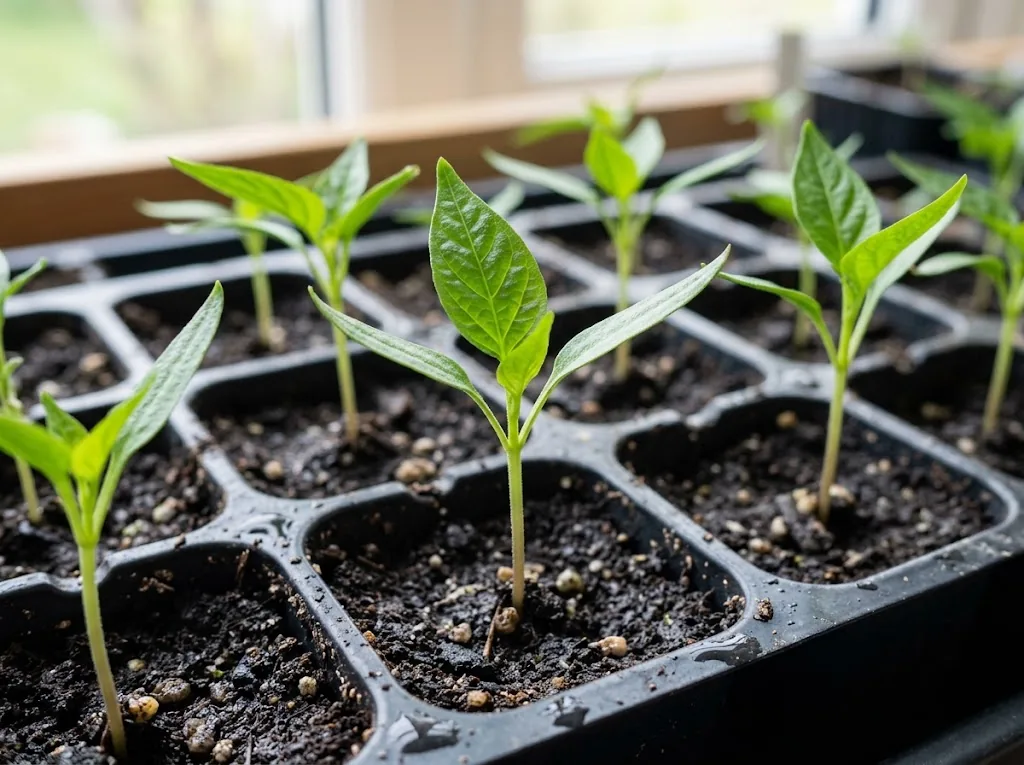
The underground architecture of a pepper plant depends significantly on how the seedling started life. When pepper seeds sprout directly in native garden soil, the embryo typically develops a central taproot capable of penetrating deep into loose subsoil. This vertical anchor helps the plant access moisture during dry spells.
When seedlings move into the garden, their taproots can be redirected and side roots spread through the upper soil. Utah State University Extension lists pepper as a shallow-rooted crop, with most effective roots in the top 6 to 12 inches. Some roots go deeper. That explains why steady moisture matters during flowering and fruit growth, while waterlogged soil still harms roots.
How a pepper plant branches and grows leaves
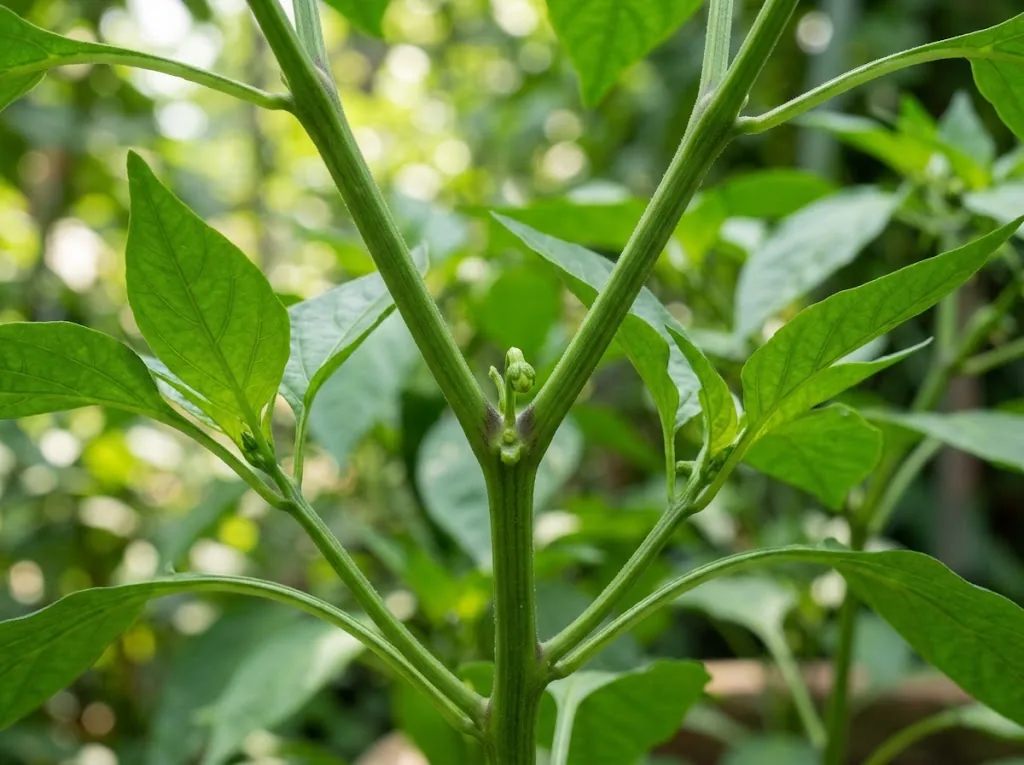
Above the soil surface, the main stem begins as a tender green shoot before developing woody secondary tissue at its base as the season progresses. Botanists describe this habit as suffrutescent, meaning a herbaceous plant that forms woody lower stems. Overall plant size varies widely, from compact container cultivars to expansive shrubs exceeding five feet in warm climates.
The main stem grows upward until it forms a flower bud. At that point, it forks into two or three branches. Later flowering nodes repeat this pattern, called sympodial growth. The forks give the plant its familiar spreading shape.
Leaves grow alternately along the stems, though they can look paired near a fork. Each has one smooth-edged blade, often oval or pointed. Leaves capture light and exchange gases through tiny pores. When a plant is stressed by heat or dry soil, it may lose water faster than its roots can replace it.
How chili pepper flowers set fruit
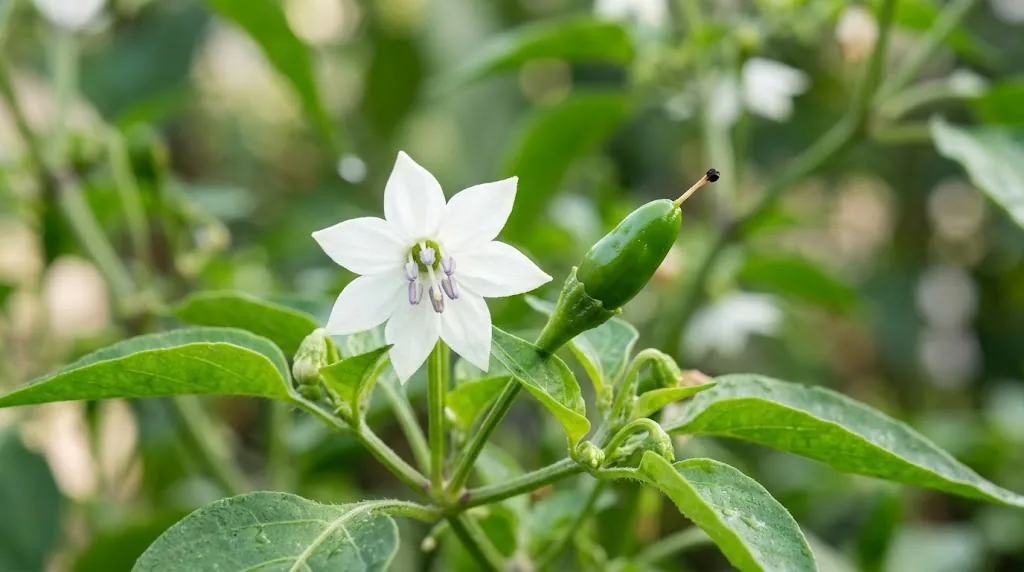
Each pepper flower is complete and perfect, meaning one blossom holds both male and female parts. Flowers appear at the stem forks, singly or in small clusters depending on the species.
The floral anatomy consists of four primary whorls:
- Calyx: A cup-like green whorl of fused sepals at the base of the flower that supports the developing blossom and remains attached to the fruit through maturity.
- Corolla: The petals, which are typically white, off-white, greenish-white, or purple (notable in Capsicum pubescens), often marked with yellow or green spots in Capsicum baccatum.
- Stamens: The male reproductive organs, consisting of thin filaments topped by anthers that produce fine pollen grains. Anthers often show distinctive pale blue or purple hues.
- Pistil: The central female organ, comprising the receptive stigma, an elongated style, and a basal ovary containing ovules that develop into seeds after fertilization.
Because the anthers closely encircle the stigma, pepper blossoms are primarily self-pollinating. Ordinary air movement, gentle vibration, or visiting insects readily transfer pollen within the same blossom. While native bees often practice buzz pollination to shake pollen free, indoor plants set fruit successfully with nothing more than light air circulation. Insects can still carry pollen between neighboring varieties, so seed savers who want true-to-type seed need to isolate their plants.
Inside a chili pepper pod
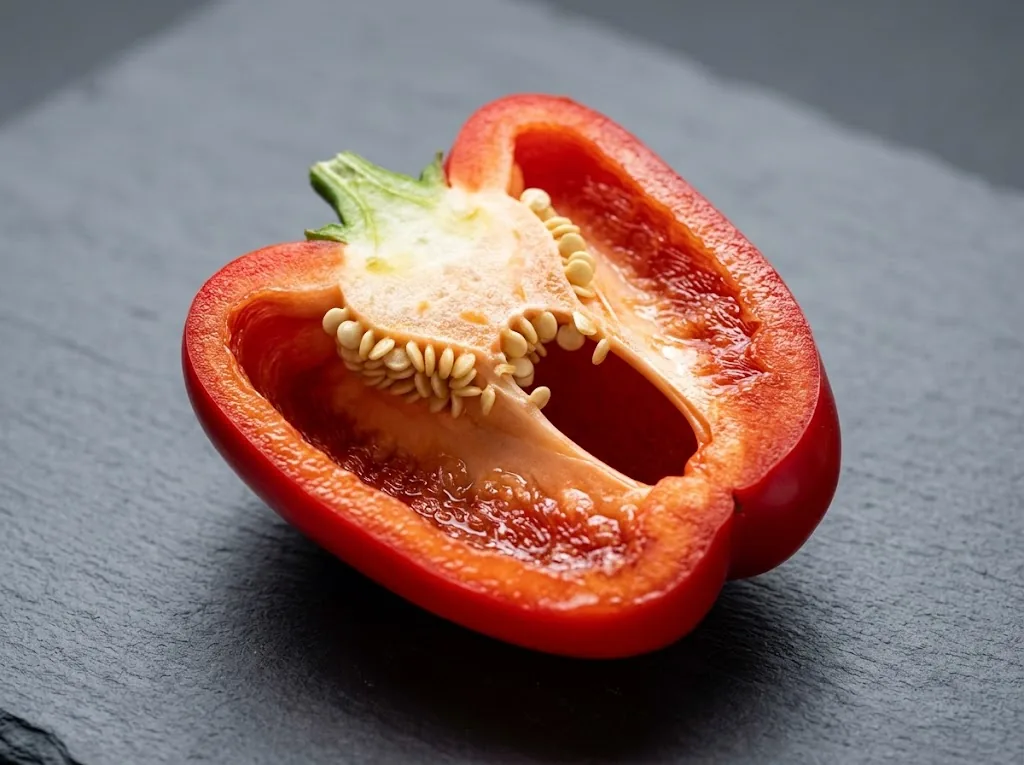
Botanically speaking, every pepper is an indehiscent berry, a fleshy fruit produced from a single ovary without opening at maturity along set lines. The anatomy of the pod includes distinct functional zones:
- Pericarp: The fruit wall, including the skin and flesh. Thick-walled bell peppers feel different from thin-walled drying types.
- Placenta: The pale tissue inside the pod where seeds attach. It is the main site where the plant makes capsaicinoids, the compounds that create heat. Some very hot varieties also produce them in the fruit wall. Seeds do not make most of this heat themselves; they can carry capsaicinoids from nearby tissue.
- Seeds: Flat, disc-shaped or kidney-shaped seeds containing an embryo and endosperm. Most species produce straw-colored seeds, though Capsicum pubescens bears rough black seeds.
- Calyx and pedicel: The green cap at the top of the fruit and its short stalk. They attach the pod to the plant.
As pods swell, cuticle micro-fissures sometimes appear as fine tan netting across the skin, a trait known as corking on peppers. This natural phenomenon occurs when fruit flesh expands faster than the outer cuticle during humid weather or sudden moisture influxes.
The pepper plant life cycle
Following the developmental arc of a pepper plant illustrates how it transitions through distinct physiological phases over time.
Seed germination
The life cycle begins within the protective coat of the seed. To germinate, pepper seeds need warmth and steady moisture. University of Minnesota Extension recommends keeping seed trays at 80 to 90°F until seedlings emerge. The emerging radicle pushes downward to anchor the plant, while the hypocotyl arches upward, lifting two narrow, embryonic cotyledon leaves toward the light.
Timing this early stage correctly ensures vigorous growth. Gardeners can reference guidelines on when to start chili seeds indoors relative to their local spring frost dates.
Leaf and stem growth
After the first seed leaves, or cotyledons, the plant makes true leaves and a stronger stem. Roots expand as the canopy grows. Gardeners usually move seedlings outdoors after frost danger has passed; the separate growing guide covers lighting and hardening off.
Flowering and fruit set
Once the main stem has grown a set number of leaves, which varies by variety, its tip turns into the first flower bud. Growers call it the crown bud. The stem then forks, and later nodes keep producing both new shoots and blossoms. After successful pollination, the petals wither and the fertilized ovary begins to grow into a pod.
Fruit growth and ripening
Developing pods expand rapidly over several weeks, accumulating sugars, organic acids, and capsaicinoids. While immature pods are still green due to abundant chlorophyll, ripening triggers biochemical shifts. As seeds fully mature, chlorophyll degrades and carotenoid synthesis intensifies. Depending on the cultivar, ripening pods shift from green to orange, red, yellow, or chocolate brown, ready for fresh use or for drying into chili powder.
Perennial growth
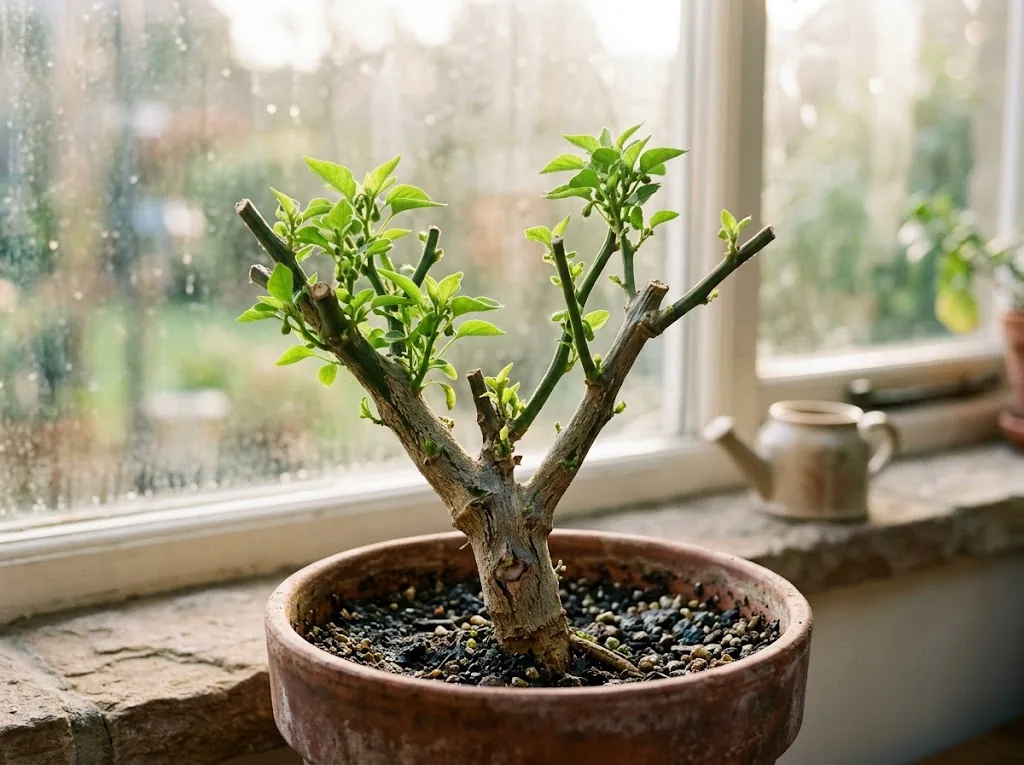
Without a killing frost, a healthy pepper can live and fruit for more than one season. Growth slows in cooler or drier periods and resumes when conditions improve. Where winters freeze, people usually grow peppers as annuals or protect a selected plant in a pot indoors.
Common questions about pepper plants
Do chili plants come back every year?
Yes, all cultivated pepper species are tender perennials. In tropical regions without frost, a healthy plant can thrive and produce fruit for several years. In temperate climates with freezing winters, plants succumb to cold unless brought indoors or protected in a greenhouse.
Why do pepper plants drop their flowers?
Heat, cold nights, and uneven watering can interrupt fruit set. University of Maryland Extension reports flower and small-fruit drop when daytime temperatures rise above 95°F or nights fall below 60°F or stay above 75°F. Fruit set often resumes when conditions improve.
Are sweet bell peppers and hot peppers the same plant species?
Many sweet bell peppers and hot cultivars such as cayenne belong to Capsicum annuum. A recessive form of the Pun1 gene explains the lack of heat in many non-pungent varieties. Other genetic routes to low heat also exist, so one gene does not explain every sweet pepper.
Where do chili peppers grow best?
Give them a sunny site, warm weather, and soil that drains well while retaining enough moisture for steady growth. Flowering and fruit set suffer in temperature extremes. For practical planting steps, see the linked growing guides rather than treating anatomy as a planting manual.
How long does a chili pepper take to grow?
It varies by variety and by whether the seed packet counts from sowing or planting outdoors. University of Minnesota Extension advises checking each variety’s days-to-maturity estimate; its crop-planning guide lists about 50 to 70 days after outdoor planting for bell peppers. Hot types and full color ripening may take longer.
Botany and growing sources
- University of Minnesota Extension: Growing peppers, for germination, outdoor planting, and temperature stress.
- Utah State University Extension: Irrigation and effective root depth, for pepper root depth.
- University of Maryland Extension: Poor blossom and fruit set, for flower-drop temperatures.
- Scientific Reports: Fruit tissues in Capsicum, for capsaicinoids in the placenta.
- The Horticulture Journal: Capsaicinoid biosynthesis, for fruit-wall production in very hot varieties.
- Heredity: Loss of pungency in Capsicum, for the recessive Pun1 variant.
- University of Minnesota Extension: Crop planning tools, for the bell-pepper maturity range.
