
Round, thick-walled cherry peppers can be eaten green, allowed to ripen red, pickled whole, or filled for an appetizer. The name covers more than one pepper line, so heat and size depend on the seed variety. Here is how to tell the common types apart, grow a hot cherry pepper from a named seed line, and choose a safe way to preserve the harvest.
For a wider look at pepper shapes and heat levels, browse our guide to chili pepper varieties.
Where cherry peppers come from
Cherry peppers are named for their compact, rounded fruit, not for a single place of origin or one cultivar. They belong to the pepper species Capsicum annuum, whose domestication has deep roots in the Americas. The USDA Agricultural Research Service describes hot pepper as one of the oldest domesticated crops of the Americas. That species-level history does not identify when or where the round cherry form was first selected, and seed catalogs use the name for several distinct lines. USDA ARS: pepper genome research
One documented food story is more recent and local. Philadelphia retailer Di Bruno Bros. says its provolone-and-prosciutto-stuffed cherry poppers grew from Italian-American family cooking and became a shop staple in the 1970s. That describes the company’s own product tradition, not the origin of every stuffed cherry pepper. Di Bruno Bros. account of its pepper shooters
What cherry peppers look like and what the name means
Common cherry types have round or slightly flattened fruit with firm, thick walls and a small hollow center. They usually set green fruit that turns red as it ripens. Exact dimensions differ: Cornell’s variety record describes its Cherry Bomb as about 2 to 2½ inches long and thick-walled, while Norseco lists the related Time Bomb F1 as round-flat fruit measuring about 3.5 by 4.5 centimeters. These are cultivar descriptions, not a size standard for every pepper. Cornell’s vegetable-variety record; Norseco Time Bomb F1 listing
“Cherry” is a shape and market description, not a promise that a pepper is sweet. Seed sellers list mild types as well as hot lines such as Cherry Bomb, Large Red Cherry, and Time Bomb. Some product labels also use pimiento or pimento for a mild red pepper, but those names do not identify every hot cherry line. Read the packet or plant label for the named variety, heat description, and days to harvest; don’t assume two packets labeled “cherry pepper” will taste alike.
Cherry Bomb peppers are a named hybrid line, rather than a synonym for every round pepper. Cornell’s listing calls it a hot hybrid and describes green fruit ripening to cherry red. Other catalogs use names such as Hot Cherry, Large Red Cherry, and sweet cherry peppers for separate lines. DeLallo also lists a Cherry Stuffer as a minimally hot type suited to filling. Green cherry peppers and red cherry peppers may be sold in jars, so check the package for the variety and heat description. DeLallo’s examples of cherry pepper types
What are the different types of cherry peppers?
Use the variety name, rather than the general label, to compare spiciness and harvest timing. These seller and university descriptions show why two packets can lead to different fruit:
- Cherry Bomb: Cornell lists a hot hybrid with thick, rounded to heart-shaped fruit that ripens from green to red.
- Large Red Cherry: Reimer Seeds lists an open-pollinated, mildly hot line, about 1 inch long by 1½ inches wide, with an 85-day estimate and a pickling use.
- Time Bomb F1: Norseco calls it a Cherry Bomb type and lists 68 days to maturity. Reimer lists 1,000 Scoville heat units, while Norseco lists 2,500 to 5,000 SHU, so treat seller heat figures as estimates that vary by source.
The maturity and heat details above apply to the named seed lines and their sellers’ listings; they are not guarantees for every plant or growing season. Cornell’s Cherry Bomb listing; Reimer Seeds’ Large Red Cherry listing; Reimer Seeds’ Time Bomb F1 listing; Norseco’s Time Bomb F1 listing
Are cherry peppers hot? How they compare with jalapeños
They can be mild or hot. A range of 2,500 to 5,000 Scoville heat units is listed for Norseco’s Time Bomb F1, which it identifies as a large Cherry Bomb type. Treat that as the seller’s figure for that named hybrid, not a measurement for all cherry peppers. Norseco’s cultivar and heat details
There is no single answer to whether cherry peppers are hotter than jalapeños because the cherry label spans different cultivars. On the Scoville scale, the University of Florida IFAS lists jalapeños at 2,000 to 8,000 SHU; Norseco’s Time Bomb F1 range overlaps that span, while mild cherry types can be far lower. Choose by the variety name and the grower’s description. For a fresh pepper, try a small piece first; the same label does not guarantee identical heat from every fruit. Most of the pungent compound is associated with the pale inner membrane, and removing that tissue can reduce perceived heat. University of Minnesota Extension: growing peppers; UF/IFAS pepper heat ranges
How to grow cherry peppers
These warm-season peppers need the same basic care as other cultivars. Small, round fruit are easy to handle, but the Cherry Bomb plant itself can grow tall, so check the named seed line’s plant size as well as its heat and maturity details before choosing a pot or bed. Start with a named seed line so you know whether the fruit should be mild or hot, and check its packet for spacing and maturity time.
- Start seeds indoors. University of Minnesota Extension recommends starting pepper seeds about eight weeks before planting outdoors. Keep the mix warm while they sprout; its guide gives 80 to 90°F as the heat-mat range until emergence. Give seedlings bright overhead light so stems stay sturdy.
- Wait for warm weather. Harden seedlings off gradually. Set them outside after frost danger has passed and nighttime lows are consistently above 50°F. Plant them at the same soil depth they had in their pots; pepper stems should not be buried deeply.
- Choose sun and draining soil. Plant in a sunny bed or a container with drainage holes. For a home garden, follow the variety’s spacing instructions. Minnesota Extension’s example spaces pepper plants 18 inches apart, with 30 to 36 inches between rows.
- Water steadily. Keep the root zone evenly moist, especially while flowers set and fruit grows. Let the soil guide watering rather than following a fixed calendar. Fluctuating moisture can contribute to blossom-end rot, a dark, sunken patch on the blossom end of the fruit; extra calcium is not a default fix. University of California Cooperative Extension guidance on blossom-end rot
- Watch before treating. Check leaves and stems for aphids, cutworm damage, or leaf and fruit spots. Identify the cause before choosing a response, and follow the product label if a treatment is needed. Rotating peppers away from tomatoes, potatoes, eggplants, and tomatillos for three or four years helps reduce the buildup of shared soil problems.
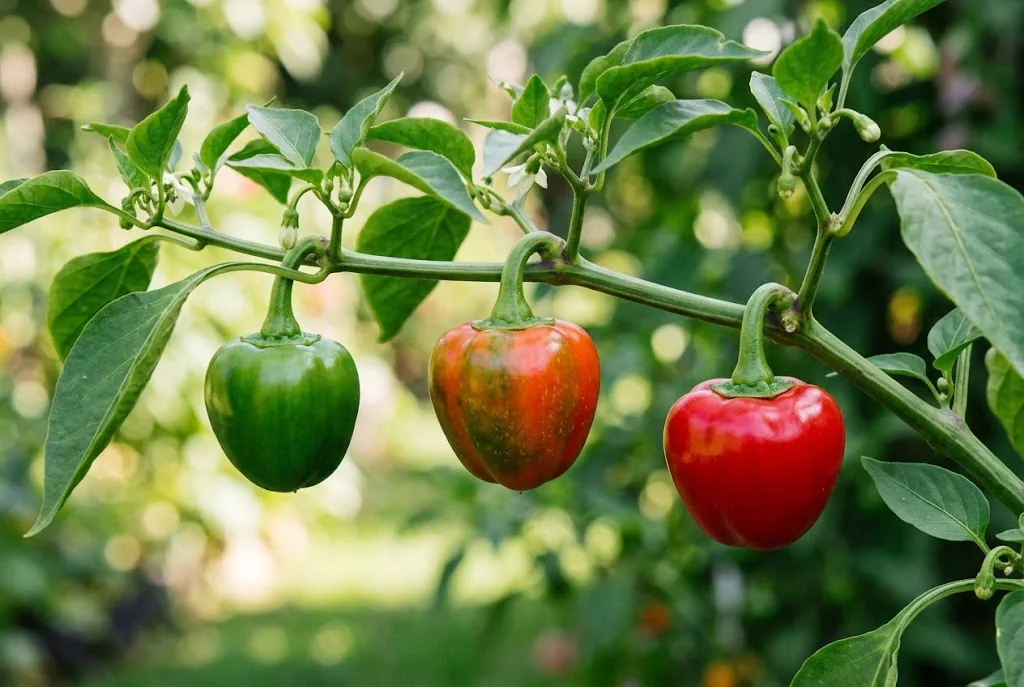
Days to maturity are estimates, not a promise. Cornell’s older Cherry Bomb listing gives a 62-to-87-day range across seed sources, while Norseco lists 68 days for its Time Bomb F1. The starting point used by a seller and the growing conditions affect the count, so use the number on the packet for your own cultivar. Cornell’s Cherry Bomb listing; Norseco Time Bomb F1
Harvesting and safe handling
Pick fruit once it reaches the size expected for its variety. Many peppers can be used green or left on the plant to color up; choose the stage that suits the dish. Snip the stem with clean shears rather than pulling hard on a brittle branch. If you are unsure how hot the variety is, handle it as a hot pepper: wear gloves, avoid touching your eyes, and wash your hands with soap and water after cutting. Minnesota Extension notes that even sweet peppers can contain enough capsaicin to irritate skin.
Want a slender, tangy pickling pepper as a comparison? Our profile of sport peppers covers a different shape and use.
Storing, drying, and preserving cherry peppers
Keep freshly picked peppers out of direct sun and handle them gently to avoid bruising. University of Minnesota Extension recommends a cool, moist spot around 55°F, using a perforated bag; if that is not practical, the refrigerator is suitable for a few days. Its estimated shelf life for peppers is about two weeks, and temperatures below 45°F can cause pitting. Discard fruit that is soft, leaking, or moldy rather than trying to preserve it. University of Minnesota Extension: harvesting and storing peppers
Cherry peppers can be frozen, dried, pickled, or used in a tested canning recipe. For drying, slice thick-walled fruit so moisture can escape, use a food dehydrator, and dry until brittle. Utah State University Extension recommends storing dried chiles in a sealed container. Wear gloves when preparing pungent fruit. Utah State Extension: preserving chiles
How to make pickled cherry peppers
Colorado State University Extension’s tested recipe for pickled peppers includes 1 pound of cherry peppers in a 5-pound mixed batch, with Hungarian or banana peppers and sweet bell peppers. For that batch, use 6 cups of 5-percent-acidity vinegar, 2 cups water, 1 tablespoon plus 1 teaspoon pickling salt, and 1 tablespoon sugar if desired; the recipe yields 7 to 8 pints. Choose high-grade white vinegar with 5 percent acidity; the guide says it can help light-colored peppers keep their color. Small cherry peppers may stay whole, but make two small slits in each so the pickling liquid reaches the hollow center. Follow the source’s altitude-adjusted boiling-water process exactly, and do not change its ingredient ratios. Colorado State University Extension’s tested pickled-pepper recipe

A refrigerator pickle is another option, but keep it refrigerated and follow a recipe written for that method. Shelf-stable pickles require a tested recipe and its specified process. Do not assume a homemade pepper-and-oil mixture is safe on the pantry shelf.
After opening a commercial jar, follow its label for refrigeration. The brine in a pickle contributes its tang, while a firm round pepper holds its shape in the jar. National Center for Home Food Preservation: pickled hot peppers
Ways to use cherry peppers
Their round shape and firm skin make cherry peppers easy to core and fill. Fresh, they can be sliced into green salads or a cooked dish; jarred, they work as a spicy-sweet condiment on antipasto platters. Their bright red color adds contrast to cheese and cured meat. Chop them into pizza, pasta salads, grain bowls, a sandwich, hoagie or panini, or blend them into a spread for crostini and dip. Some shops sell sliced hot cherry peppers in jars for quick use as a topping. To make a simple stuffed appetizer, drain and pat dry a pickled pepper, then fill its hollow center with provolone cheese and prosciutto for a savory stuffing. Retailers also suggest charcuterie, wraps, and salad bars. A mild sweet cherry pepper adds color with little heat; a hot named cultivar gives a sharper bite. DeLallo’s cherry-pepper serving ideas

Another variety with an upright fruiting habit and its own regional name is the Facing Heaven pepper. Keep that comparison brief: cherry peppers are defined by their round fruit, while other named varieties have their own shape, heat, and growing profile.
Frequently asked questions
Can you eat cherry peppers raw?
Yes. Rinse them under clean running water, remove the stem, and slice or bite into a small piece. If the cultivar is hot, the pale inner membrane and seeds can carry much of the heat, so remove them if you want a milder bite. Wear gloves when handling a hot variety. University of Minnesota Extension: pepper handling
Are cherry peppers spicier than jalapeños?
Not as a group. Cherry peppers range from mild to hot, and the name alone does not tell you where a fruit sits. Compare named varieties using the seed seller’s stated heat range, and sample cautiously when the source is unknown.
What is the difference between Cherry Bomb and a sweet cherry pepper?
Cherry Bomb is a named hot hybrid. “Sweet cherry pepper” describes a mild type sold under its own seed-line or product name. Both can have round fruit, but their heat and exact size differ, so check the cultivar label.
Can I can my own cherry pepper recipe?
Yes, if you use a tested recipe that specifies cherry peppers and follow its ingredient ratios and altitude-adjusted processing time. Colorado State University Extension’s recipe includes cherry peppers in a mixed batch. If you are making an improvised refrigerator pickle, keep it cold instead of treating it as pantry-safe.
Do cherry peppers have different nutritional values?
There is no single nutrition figure for every cherry pepper: variety, ripeness, and whether it is fresh, dried, or pickled change what a serving contains. The USDA FoodData Central pepper fact sheet describes chile peppers as an excellent source of vitamin C and gives 27 milligrams per 30 grams for jalapeño. That is a jalapeño reference, not a lab value for a cherry cultivar. USDA FoodData Central pepper fact sheet
