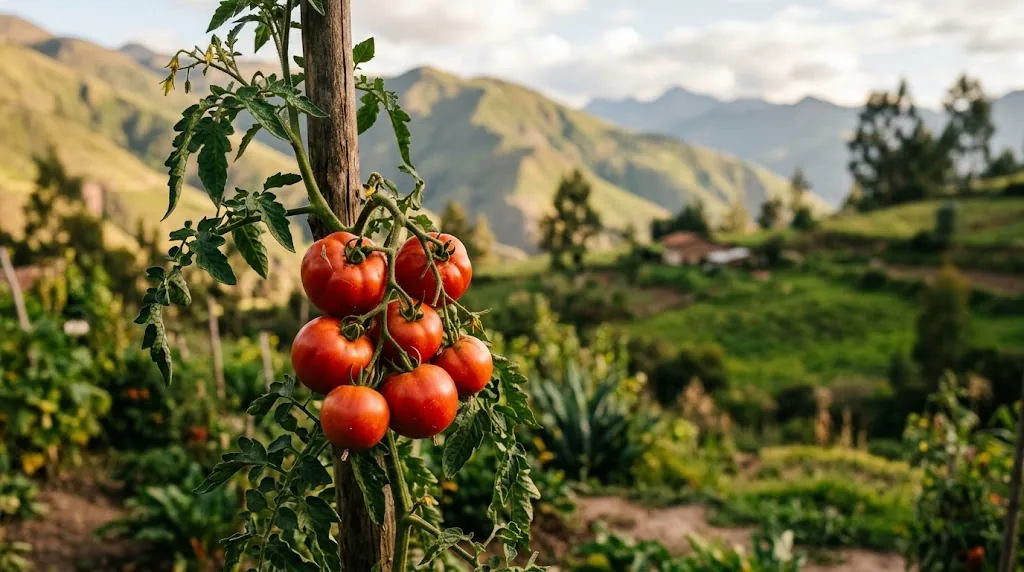
Tomatoes began as wild relatives in western South America, but the familiar cultivated crop took shape through human selection in the Americas, especially Mesoamerica. Spanish colonial exchange carried tomatoes across the Atlantic in the sixteenth century. From there, cooks and growers in Europe and later other regions turned a little-known plant into one of the world’s most recognizable foods. The evidence is clear about that broad journey, but researchers still debate the exact route and timing of domestication.
If you are growing tomatoes today, the fruit in your garden is the end point of a long story of movement, cultivation and selection. For a practical path from history to the garden, start with our guide to growing tomato plants.
Wild roots in the Andes
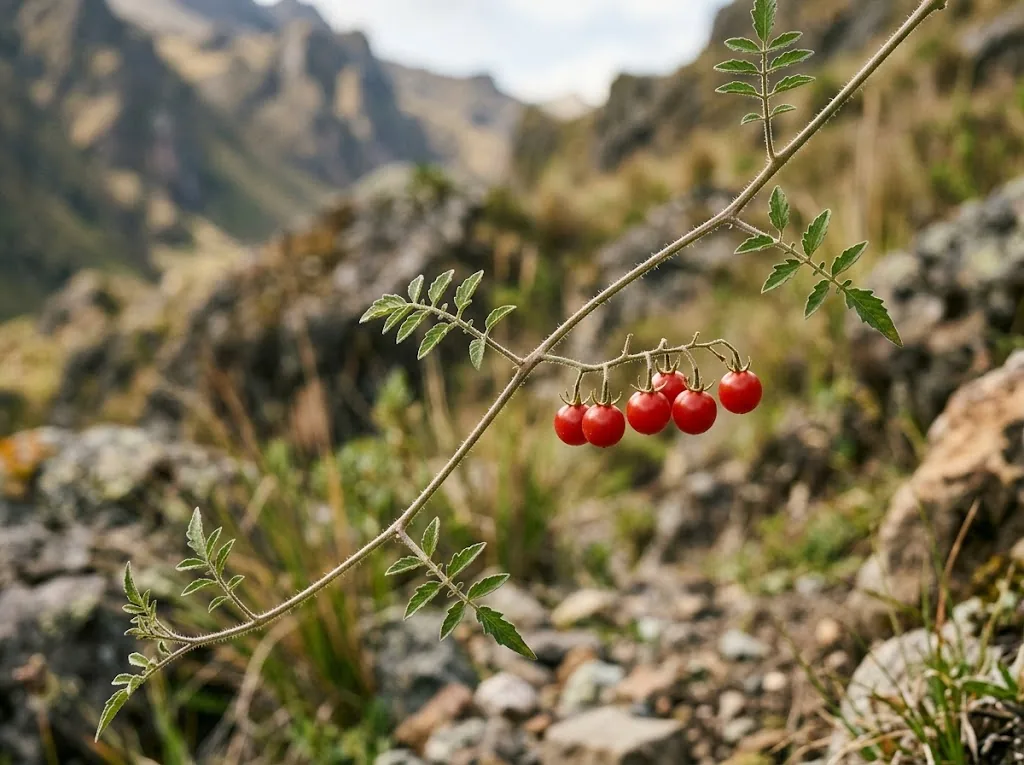
The closest wild relative of the cultivated tomato, Solanum pimpinellifolium, grows from Ecuador to northern Chile, including Peru. Its small red fruits look more like a currant tomato than the large slicing tomatoes common today. Even so, the crop did not arise from this plant in a single step.
Genetic studies describe a gradual, multi-stage process. A cherry-sized intermediate, often called Solanum lycopersicum var. cerasiforme, is found across parts of South America and Mesoamerica. Earlier models proposed that people first selected this intermediate in the Andes Mountains and that later selection enlarged the fruit in Mexico. Newer genomic work finds a more complicated pattern, with several regional populations and possible movement in more than one direction. A modern cherry tomato gives a familiar scale for some small-fruited forms, though it is not a living stand-in for the exact ancestor. The precise path and dates remain unsettled, so a neat single-origin timeline would claim more than the evidence can show. Compare a 2019 genomic study of domestication with a recent review of tomato genomics and breeding.
Indigenous farmers shaped the cultivated tomato
Although the tomato’s wild relatives are South American, the large-fruited crop was established in Mesoamerica before Europeans arrived. Indigenous farmers grew and selected plants for fruit size, color, shape and culinary use. This long period of care is central to the crop’s history. The tomato did not become a food only after it reached Europe.
Sixteenth-century Nahuatl sources preserve evidence of a varied tomato culture. The University of Oregon’s Online Nahuatl Dictionary cites the Florentine Codex’s lists of tomato sellers offering fruits of different colors, sizes and shapes. A related entry from the early seventeenth century lists tomatoes among foods people planted and ate with beans, amaranth, chia and chiles. These records show that tomatoes belonged to an established Mesoamerican food system, rather than arriving as a novelty without culinary context.

Names also carry this history. Spanish tomate came through a Nahuatl word, while Spanish accounts and plant transfers carried the crop into European records. The wording changed across languages, and different names could refer to distinct tomato-like plants. For a closer look at how tomato variety names preserve place, people and stories, see our guide to tomato names.
Tomatoes cross the Atlantic
Spanish colonists carried tomato seeds from the Americas to Europe during the sixteenth century, but surviving documents do not name one precise arrival date or the person who transported them. Because plant transfers were rarely written down, historians rely on later descriptions and illustrations of the tomato plant rather than a shipping record.
Italian physician and botanist Pietro Andrea Mattioli described a tomato-like plant in a 1544 edition of his commentary on Dioscorides, comparing it with eggplant. In a 1554 edition, he used the name pomi d’oro, or “golden apples.” A peer-reviewed study of sixteenth-century European tomato records compares early illustrations and texts, showing how botanists relied on reports, specimens and drawings from other people. The surviving record therefore documents what entered print and pictures, not the full path of the crop through the Americas.

Why did people call tomatoes poisonous?
Some writers in Europe expressed suspicion about tomatoes, and the plant belongs to the nightshade family, which includes toxic relatives such as deadly nightshade. But the familiar claim that acidic tomato juice leached enough lead from diners’ plates to poison them is not a sound explanation for the fear. The story appears in modern retellings, yet historians and toxicology commentators dispute it. Smithsonian’s history account traces suspicion in Britain partly to early herbal writing that described the plant and fruit negatively, while noting that the plate-and-lead explanation does not hold up. By the 1700s, warnings persisted in some English-language books, even as tomatoes were already eaten elsewhere.
Attitudes were not uniform across Europe. Mattioli’s description already noted eating tomatoes in an eggplant-like way, while other writers repeated warnings. The recorded European warnings come from herbals; the plate-and-lead story appears in later retellings. The crop could be grown as an ornamental or discussed by botanists in one setting and used as food in another. One label such as “poisonous” cannot summarize every region or household.
Tomatoes become part of Italian cooking
Tomatoes entered European kitchens gradually, rather than instantly transforming Italian food. Before tomatoes from the Americas became part of Italian cooking, regional meals drew on a wider Mediterranean pantry. A historical review describes a classical food pattern centered on cereals, olives and grapes, with legumes and sheep and goat cheeses alongside them. This gives useful context, not a claim that every Italian region ate the same menu. Tomato-based cooking emerged through later experimentation and exchange, as the historical overview of the Mediterranean diet helps show.
The first surviving Italian cookbook known for tomato recipes is Antonio Latini’s Lo scalco alla moderna, published in Naples in 1692 to 1694. A scholarly edition and translation describes it as the earliest book to publish recipes using tomatoes and chiles. The text includes a Spanish-style sauce, an early printed tomato sauce recipe. That date marks a written recipe, not the first time anyone in Italy tasted or cooked a tomato; it shows that tomato preparations had entered a printed culinary tradition by the late seventeenth century.

Over time, cooks adapted the fruit to local dishes and preferences. Tomato sauces and preserved preparations became associated with many regional cuisines, while the crop also traveled through trade and migration. The familiar pairing of tomato with pasta is one chapter in that longer process, not a tradition that began as soon as the plant arrived.
From an American garden plant to a world crop
Tomatoes crossed into other parts of the world through colonial trade and later commercial agriculture. Their adoption took different routes: some communities first grew them ornamentally, others cooked them, and still others incorporated them as farming and food markets changed. In British North America, historical accounts place early references in the colonies in the eighteenth century. By the nineteenth century, newspapers and cookbooks increasingly treated tomatoes as familiar ingredients.
Modern breeding widened the range of fruit sizes, shapes, colors, firmness and growing traits. Genomic research traces how people selected these features, from the small-fruited ancestors to cultivated tomatoes with much larger fruits. Breeders have also used the diversity of wild relatives to study traits such as disease resistance and stress tolerance. The modern crop is not one uniform tomato: tomato varieties include fresh-market slicers, processing types, cherry and paste tomatoes, heirlooms and hybrids shaped for different needs.
Botanically, a tomato is a fruit, while cooks often use it as a vegetable because of its savory role in meals. If that distinction is what brought you here, our explanation of whether a tomato is a fruit or vegetable covers the botanical and kitchen meanings.
Frequently asked questions
Where did tomatoes originally come from?
Wild tomato relatives are native to western South America, including the Andean region. Indigenous people cultivated and selected the crop in the Americas, with Mesoamerica central to the development of the large-fruited tomato.
Did Indigenous people eat tomatoes before Spanish arrival?
Yes. Nahuatl-language sources from central Mexico describe tomatoes in markets and as foods people grew and ate. These records predate the tomato’s introduction to Europe.
Why did some people think tomatoes were unsafe to eat?
Some early writers distrusted the plant, and its botanical relatives include toxic species. The often-repeated story that tomato acidity poisoned diners by leaching lead from plates is disputed and should not be presented as established fact.
When did Italians start cooking with tomatoes?
Tomatoes appear in a surviving Italian cookbook by Antonio Latini in 1692 to 1694. That gives a documented date for printed recipes, not necessarily the first tomato meal made in Italy.
A crop with a shared history
The tomato’s journey connects Andean wild plants, Indigenous cultivation in Mesoamerica, Spanish colonial movement and centuries of adaptation by cooks and growers around the world. Its exact domestication route is still being refined, but one point is clear: the crop’s story began in the Americas long before it became a fixture in European kitchens. The tomatoes we grow and eat today carry that layered history in every size, color and use.
