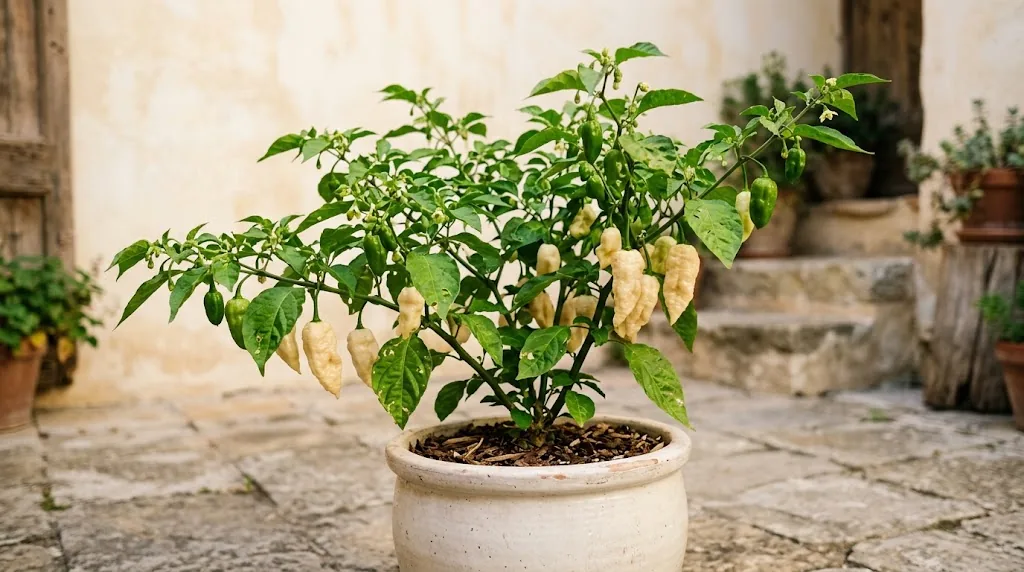
A ripe White Ghost pepper looks almost pale enough to be mistaken for an ornamental fruit. This pepper is sold as Capsicum chinense, and its light appearance does not mean mild flavor. Also sold as White Bhut Jolokia, this pale selection keeps the sharp, fruity character associated with ghost peppers while giving cooks and gardeners a less common hue.
If you are comparing unfamiliar varieties, our guide to different types of chili peppers puts ghost peppers in context with other shapes, flavors, and pungency levels.
What is this pale ghost pepper?
This pale-fruited selection belongs to the ghost pepper group associated with northeastern India. Research on Bhut Jolokia regional diversity describes it as a highly variable Capsicum crop from that region, while seed sellers such as Tomatofifou describe the ivory form as a color variant of the red type. The exact pedigree of a packet labeled by this common name is not consistently documented, so treat it as a seller’s line name rather than proof of one standardized lineage.
The species name used by seed suppliers is Capsicum chinense. Despite the name, this species is not from China. Ghost pepper fruit can vary in shape and size between lines, so photographs and descriptions from a particular supplier are more useful than assuming every plant will match one fixed standard.

Appearance, heat, and flavor
Unripe fruit is usually green, then matures to cream, ivory, or pale yellow, depending on the seed line and growing conditions. Tomatofifou’s catalog describes its pods as hanging, conical fruit about 4 to 6 cm long and 2 to 3 cm wide, with rough skin. Other lines may differ, so buy from a supplier that shows mature fruit from its own stock if appearance matters.
Seed catalogs publish only rough heat figures for this selection. Tomatofifou lists about 800,000 SHU for its White Bhut Jolokia line. That is a seller’s estimate for a named line, not a lab result for every fruit, and other catalogs may give different numbers. Pungency changes with genetics, maturity, and growing conditions. Handle it as a superhot chili even when an individual fruit tastes less fierce.
Growers and sellers describe the flavor as fruity, with the familiar pungent ghost-pepper bite. That flavor can be difficult to notice unless you use a tiny amount: the burn quickly dominates. A small piece can season a pot of stew, and you can always add more after tasting.
If you want to compare another very hot C. chinense variety, the 7 Pot Douglah profile covers a dark-fruited pepper with a different appearance.

How to grow white ghost pepper from seed
This pepper needs a long, warm growing season. Start it indoors rather than waiting for outdoor soil to warm. New Mexico State University’s Chile Pepper Institute recommends soil temperatures around 80 to 85°F for chile germination and notes that chinense types can take up to five weeks. Use a clean starting mix, keep it evenly moist rather than saturated, and be patient if emergence is slow. Once seedlings appear, move them under strong light so they grow compactly.
Pot seedlings into individual containers after true leaves develop. Before planting outdoors, harden them off gradually over about a week. Set them outside only after frost danger has passed and nights are reliably warm. North Carolina State Extension recommends waiting until nighttime temperatures reach at least 55°F for C. chinense; colder conditions can stall or injure a warm-season pepper.
Choose a sunny spot with fertile, well-drained soil. A large container also works if it has drainage holes and enough volume to keep the roots from drying too quickly. University of Maryland Extension recommends at least a five-gallon container for peppers. Water at soil level when the surface begins to dry, then let excess drain away. Steady moisture helps avoid swings between drought and saturation.
Feed according to a soil test or fertilizer label instead of adding extra nitrogen by guesswork. Utah State University Extension cautions that over-fertilizing can encourage excess foliage and delay fruit set and maturity. Stake a heavily loaded plant if branches begin to bend, and check leaves for pests or disease. If growth slows in a cool summer, use the warmest available site and protect the plant from chilly nights; there is no reliable shortcut that guarantees a harvest date.
For a different garden scale and species, see the Joe E. Parker pepper profile, which covers a milder Capsicum annuum type.
Harvesting and handling the pods
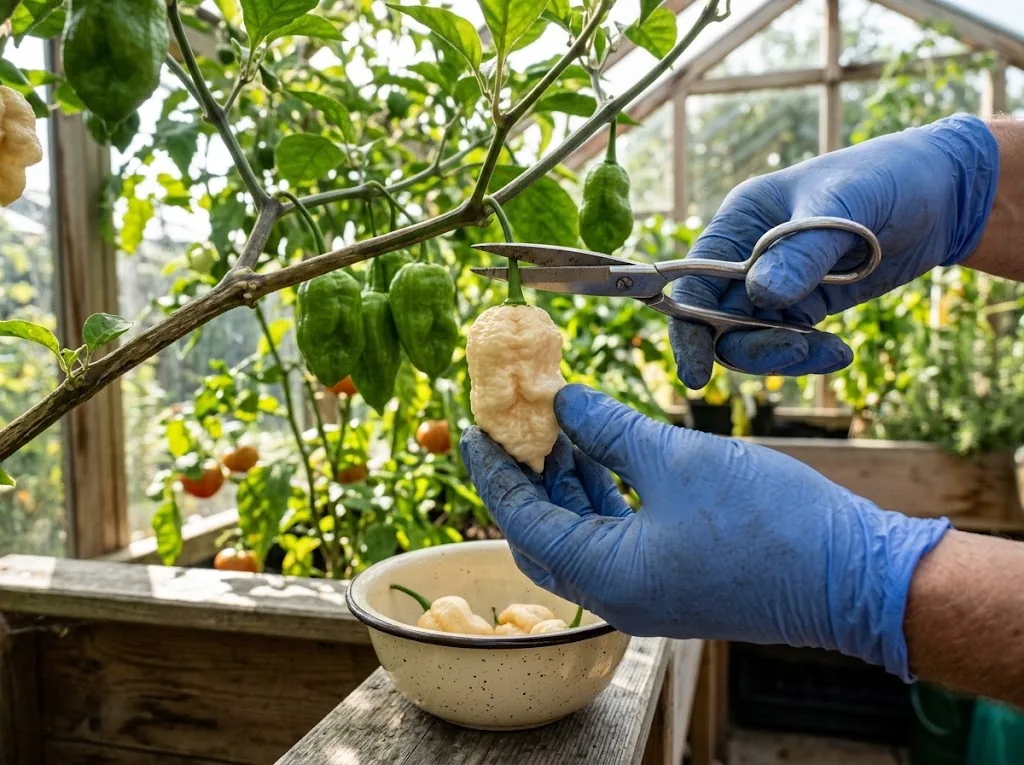
Pick fruit when it has reached its mature ivory hue and feels firm. The days to harvest depend on the seller’s line and climate, so use the packet’s estimate as a guide. Use clean snips to avoid pulling branches, and wear gloves while handling the fruit. Keep your hands away from your eyes and face, and wash tools and work surfaces after cutting. Poison Control recommends gloves and advises rinsing capsaicin from an affected eye with plenty of warm water.
Label the harvest and prepared condiments clearly, and store them where children and pets cannot reach them. If juice gets on skin, follow Poison Control’s advice rather than rubbing your eyes or face.
Storing and preserving white ghost peppers
Keep fresh chiles refrigerated and use them within a few weeks, or freeze them for longer storage. Utah State University Extension gives two to three weeks as a storage guide for fresh chiles, while noting that storage temperature matters. For drying, use a dehydrator until the fruit is thoroughly dry and brittle, as University of Minnesota Extension describes. Store dried peppers in a sealed container in a cool, dark place, then crush only what you need.
The peppers can season a cooked condiment, flakes, or a small amount of a dish. Follow a tested recipe for any shelf-stable canned product, such as the National Center for Home Food Preservation hot sauce recipe. An improvised vinegar mixture, oil infusion, or pickle belongs in the refrigerator; do not assume extra vinegar or a long simmer makes an untested recipe safe for pantry storage.
Ways to use the fruit
Use this pepper sparingly where its pale appearance and fruity pungency suit the dish. Mince a small amount into a cooked condiment, blend a sliver into fresh salsa, or dry and crumble it into a labeled shaker. Start with less than you think you need, taste the food, and add more in small increments. Avoid barehanded contact, and wash the knife, work surface, and hands thoroughly afterward.
This strain suits gardeners with a warm, long season and cooks who enjoy serious pungency. Its ivory fruit is distinctive, but names and traits can vary between suppliers. Buy from a seller that identifies its line clearly, grow it warm, and handle the crop with care.
