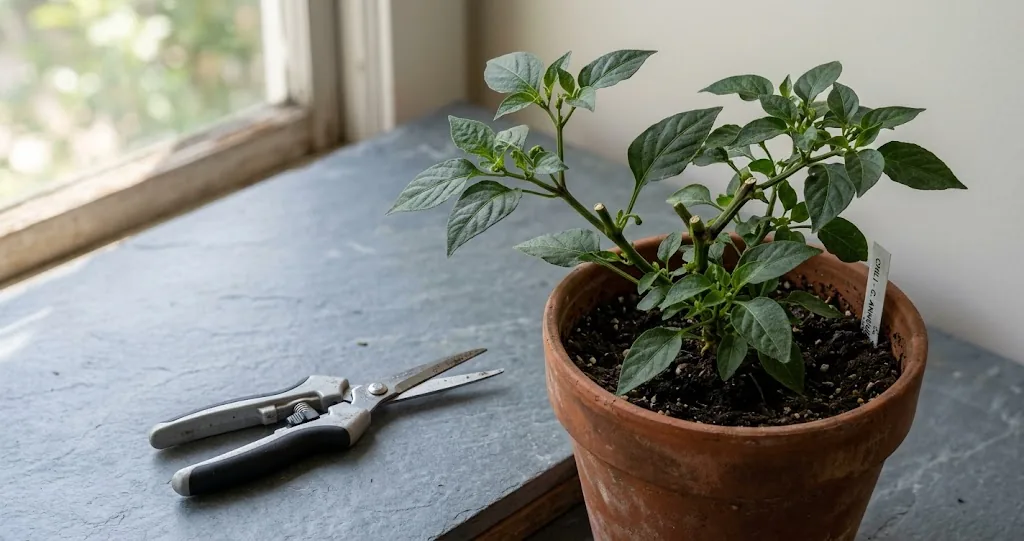
Pruning is one of those small jobs that pays back many times over the season. A clean cut above the right leaf node, made at the right moment, sends energy into sturdier branches and heavier fruit instead of thin, leggy stems that flop in summer wind. Done badly or at the wrong time, it can stall a specimen for weeks. Done well, it is the difference between a handful of pods from a tired-looking bush and a heavy harvest that runs from midsummer through the first cool nights of autumn.
This guide covers when to top, when to pinch flowers, how to make a proper cut, and how the five domesticated Capsicum species differ in their response to the snips. It is written for home gardeners raising peppers in pots, raised beds, or open ground, and it answers the questions that come up once a specimen is past the seedling stage and the gardener starts wondering whether to take the secateurs to it.
Do these plants actually need pruning?
Short answer: no, a Capsicum bush will flower and fruit without ever being touched. Cutting is not survival. It is a way of shaping the canopy so the energy it would have spent on weak stems or premature flowers goes into the harvest you actually want. For most home gardeners, the single highest-value cut is topping the seedling once it has six to eight true leaves. Beyond that, light midseason shaping and end-of-season cleanup cover nearly every practical need.
The honest case for skipping the snips: a specimen that is already branching well, getting full sun, and not flopping under its own weight does not need a stylist. The honest case for cutting: a leggy seedling, a crowded container, or a tall variety that has put all its energy into one leader. Read the bush before reaching for the snips.
What are the benefits of pruning?
The benefits show up in five concrete ways:
- Better branching. Pinching out the main growing tip breaks apical dominance, which is the habit of sending hormones up to a single leader. Side shoots wake up, and the bush fills out into a sturdier shape.
- More flowering sites. New branches can create additional places for flowers to form. Whether that produces a larger harvest depends on the variety, season length, light, and how much foliage the cut removes.
- Improved airflow. Thinning the inner canopy lets air move through, which dries leaves faster after rain and reduces the surface area where fungal spores like to settle.
- Easier harvesting. A compact bush with visible pods is faster to pick than a tall, floppy one where the fruit hides deep inside the canopy.
- Cleaner end-of-season cuts. A specimen that has been shaped during the season takes a tidier cut back in autumn if you plan to overwinter it indoors.
The trade-off is real and worth naming: a cut can delay flowering while the bush redirects its energy into new shoots. Whether topping pays off depends on the variety, the timing, and how much warm weather remains. In a short season, a gardener racing frost may be better off leaving a healthy bush alone.
When is the best time to prune?
Three windows cover almost every practical cut.
Topping at the seedling stage
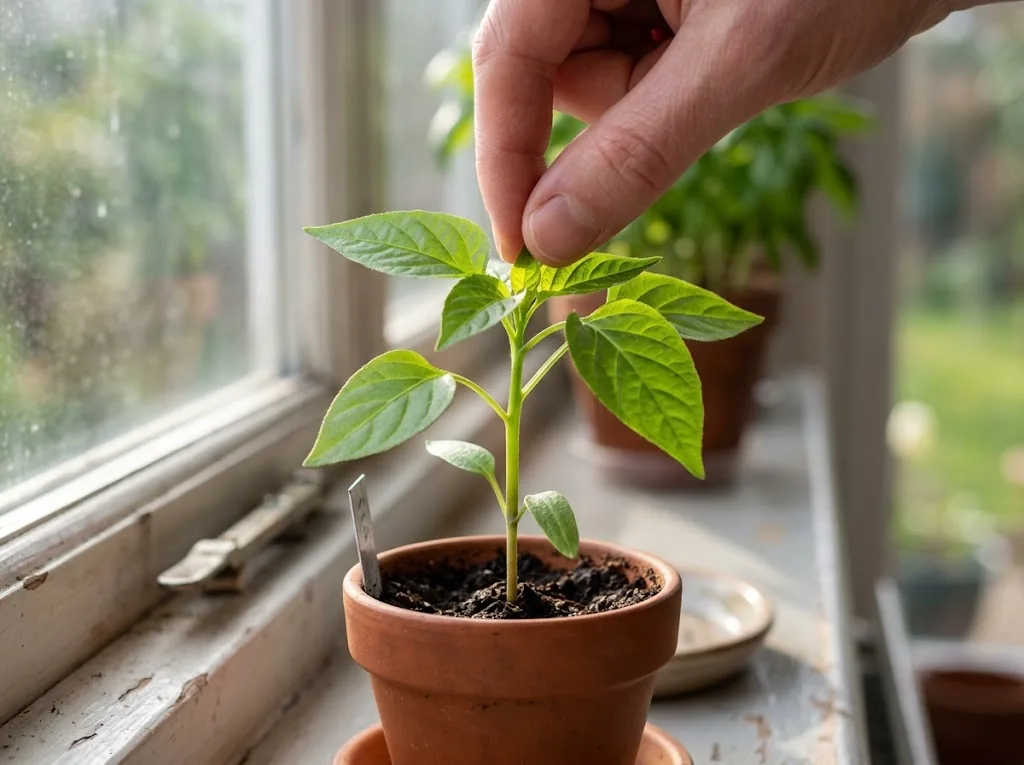
Once a seedling has six to eight true leaves and is starting to look tall rather than bushy, pinch out the very top growing tip just above the second set of true leaves. This is the single most useful cut most peppers will ever receive, because every branch that follows traces back to this decision. Use clean fingernails or fine snips. The seedling will look bare for a few days and then push two new leaders from the node below the cut.
Midseason shaping
Once the bush is established and starting to set flower buds, the next useful job is removing the inward-facing and crossing branches that will crowd the center of the canopy. Take any branch that crosses another, any sucker that points back into the middle of the bush, and any thin, weak stem that is clearly going to be shaded out. Do this before the bush is in full flower, so the cuts heal while there is still vegetative energy to spare.
End-of-season cleanup
For specimens coming inside for the winter, cut the canopy back by about a third, remove any pods that will not ripen, and clean up the center. This is also the moment to take hardwood cuttings for propagation if you want to clone a favorite variety. For bushes finishing in the garden, a final tidy cut makes it easier to compost the top growth and lift the roots.
How do you prune without hurting the plant?
The technique matters more than the amount. A few habits make every cut a good one.
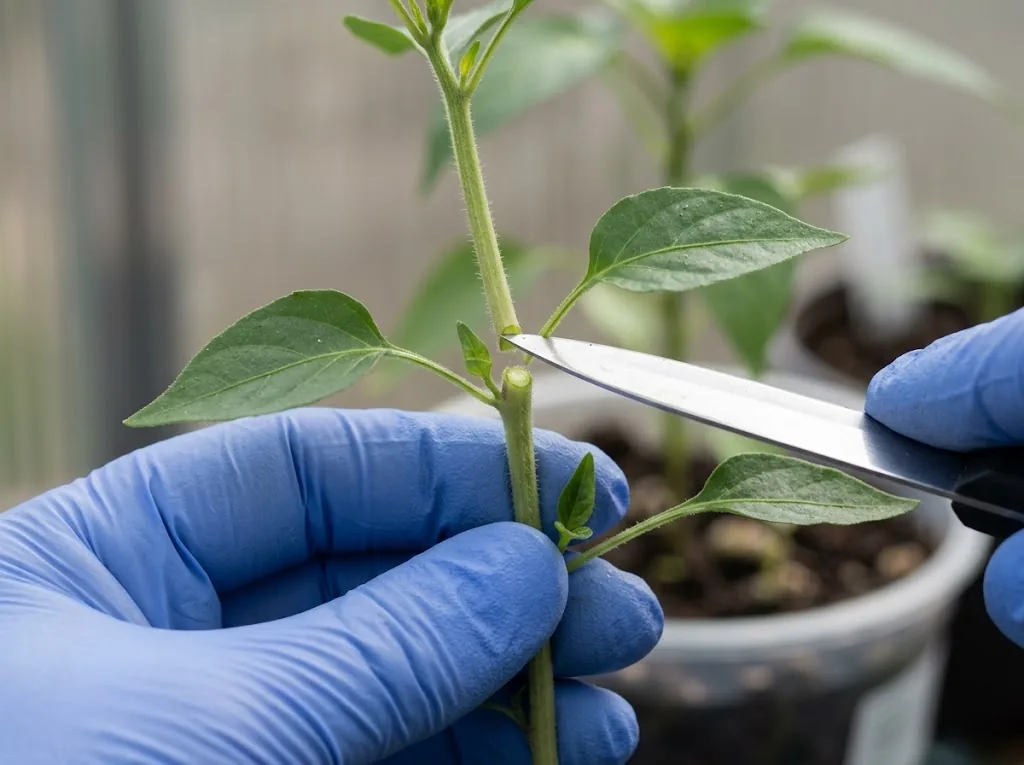
- Use clean, sharp snips. Scissors or fine pruning snips wiped with a cloth dipped in rubbing alcohol between specimens prevent spreading any virus that might be present. Ragged cuts crush the stem and heal slowly.
- Cut above a leaf node, never mid-stem. A leaf node is where a pair of leaves meets the stem, or where a side branch leaves a main stem. Cut about 5 mm above the node at a slight angle so water runs off rather than pooling on the cut.
- Leave the node’s leaves in place. The leaves attached to the node are the engine that drives the two new shoots you want to wake up. Removing the node and its leaves defeats the purpose.
- Work in dry weather when the bush is not water-stressed. Cuts heal fastest on a turgid specimen in the morning, before the heat of the day. Avoid cutting right before a heavy rain, which sits on fresh wounds.
- Step back after every third cut. It is easy to overdo it. Pause and look at the overall shape before deciding on the next cut.
Should you cut the top off?
Yes, once. Topping a seedling is the single highest-leverage cut, and almost every Capsicum species responds well to it. The point is timing: wait until the seedling has at least six true leaves, so the stem has hardened and there is enough leaf area to recover quickly. Pinching off the top of a very young seedling with only two or three true leaves can stunt it, because there is not enough foliage left to drive new shoots.
After the first topping, leave the central leader alone for the rest of the season unless it is clearly outgrowing its space or shading its neighbors. Repeated topping on the same bush produces a dense, low shape, which can be useful for small containers but cuts the canopy’s sun exposure and is not the goal in an open bed.
Should you remove early flowers?
Often yes, especially on bushes that are still small or in short-season gardens. A specimen that flowers before it has built a strong framework often produces a small early pod at the expense of a much larger harvest later. Pinching off the first flower cluster lets the bush put its energy into branches and leaves for another two or three weeks before fruiting kicks in.
For tall, vigorous varieties like cayenne, ají, or Tabasco, early flowers are not a problem and can be left alone. For compact ornamentals, super-hot varieties that take a long time to ripen, or any bush in a small pot that is struggling to fill its space, pinching the first cluster is usually worth the delay. The decision is local: judge the specimen, not the calendar.
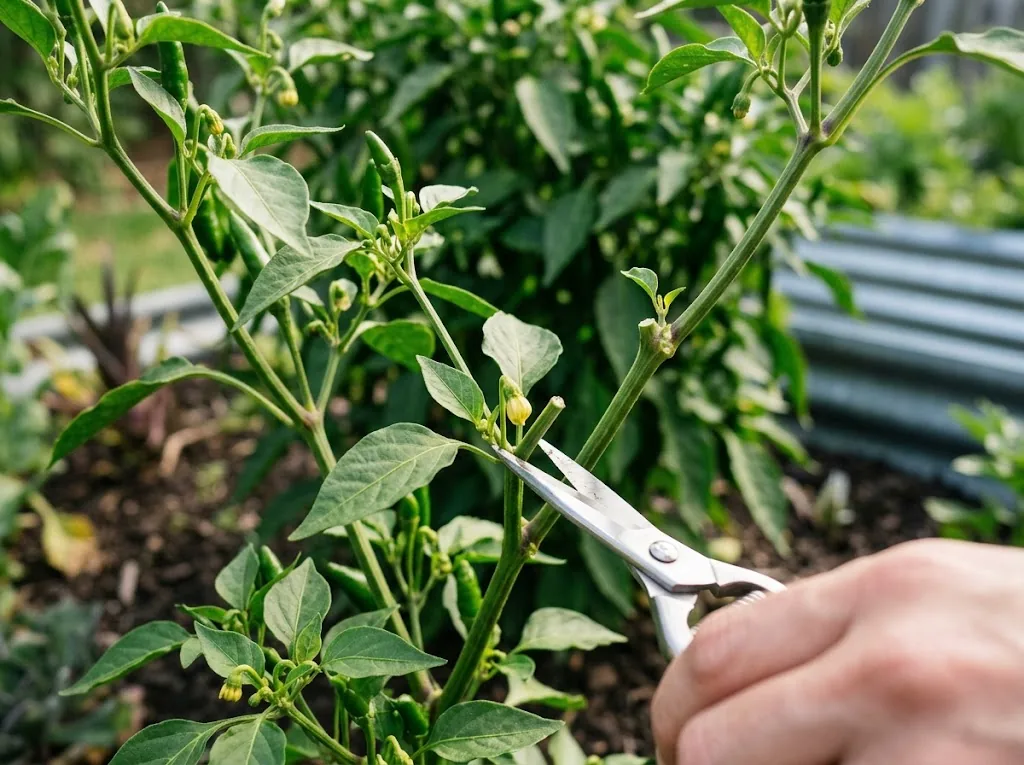
If a bush is dropping flowers instead, see why chili flowers drop and how to fix it.
Does pruning work on every kind of Capsicum?
No. The five domesticated Capsicum species respond differently, and a one-size approach will underperform in some.
- Capsicum annuum (jalapeño, cayenne, poblano, most sweet and wax peppers) responds strongly to topping and produces a sturdier bush quickly. This is the species that benefits most from the standard seedling cut.
- Capsicum chinense (habanero, ghost, Scotch bonnet, Fatalii) branches naturally and responds well to topping, but it expands slowly. Pinch early and only once; overdoing it delays flowering noticeably.
- Capsicum frutescens (Tabasco, African bird’s-eye, siling labuyo) tends to grow tall and skinny. Topping helps, and light midseason shaping prevents the leader from flopping.
- Capsicum baccatum (ají amarillo, ají lemon drop, Bishop’s crown) expands into a tall, open shrub. Pinch only the seedling once and otherwise leave it alone. Heavy cutting reduces flower production more than it helps the shape.
- Capsicum pubescens (rocoto, manzano) is a cool-climate species with hairy leaves and woody stems. It develops slowly and resents hard cutting. Top once at the seedling stage and then leave it alone.
For an unknown variety, the safe default is one pinch at the seedling stage and one light midseason shaping. If the bush is clearly vigorous, that is enough.
Can you prune potted specimens?
Yes, and in many cases you should cut more aggressively on a potted specimen than on one in the ground. Containers restrict root size, which restricts canopy size, and cutting is the cheapest way to match the canopy to the root system the bush actually has. A heavy cut on a potted specimen that has been in the same container for a year is a good moment to refresh the compost and step the bush up to a slightly larger pot if the roots have filled the space.
Two specific pot situations to handle with the snips:
- Tall bushes in small pots. A specimen that is taller than its container is wide is a candidate for a hard cut. Reduce the canopy by a third, refresh the compost, and resume normal watering once new shoots appear.
- Crowded indoor bushes over winter. Indoor peppers under low light get leggy fast. A clean cut above a strong node before bringing the bush inside will produce a tighter, more productive shape through the dark months.
How does pruning affect yield?
The honest answer is that pruning does not guarantee a larger harvest. Its effect depends on the variety, season length, light, root space, and timing of the cut. Penn State notes that pruning is common in protected crop production and can improve fruit quality, but it also adds labor and needs to suit the growing system. For a home garden, treat topping as a way to shape a leggy young bush, then judge the result in your own conditions rather than expecting a fixed yield increase. Penn State Extension guidance is a useful reference for the wider growing requirements.
If you top, do it once while the seedling is healthy and has enough leaves to recover. Beyond that, keep cuts light and use them to remove damaged, crossing, or crowded stems rather than chasing a promised harvest figure.
How many years do pepper bushes last, and how does pruning help?
Most peppers are grown as annuals in temperate climates because they cannot survive frost. In their native range, Capsicum bushes are short-lived perennials that can fruit for three to five years before woodiness and falling production make them worth replacing. In a warm climate or indoors under lights, a single specimen can be kept productive for several seasons by overwintering it.
Pruning matters most for overwintered bushes. Each autumn, before bringing the specimen inside, cut the canopy back by a third, remove any pods that will not ripen, and clear the center. The bush regrows from the framework the cut leaves behind. Without that annual shaping, an overwintered pepper becomes a woody, sprawling thing with leaves only at the tips and very few flowers. For the full overwintering routine from cutting back to bringing the bush back outside in spring, see the guide on overwintering these plants.
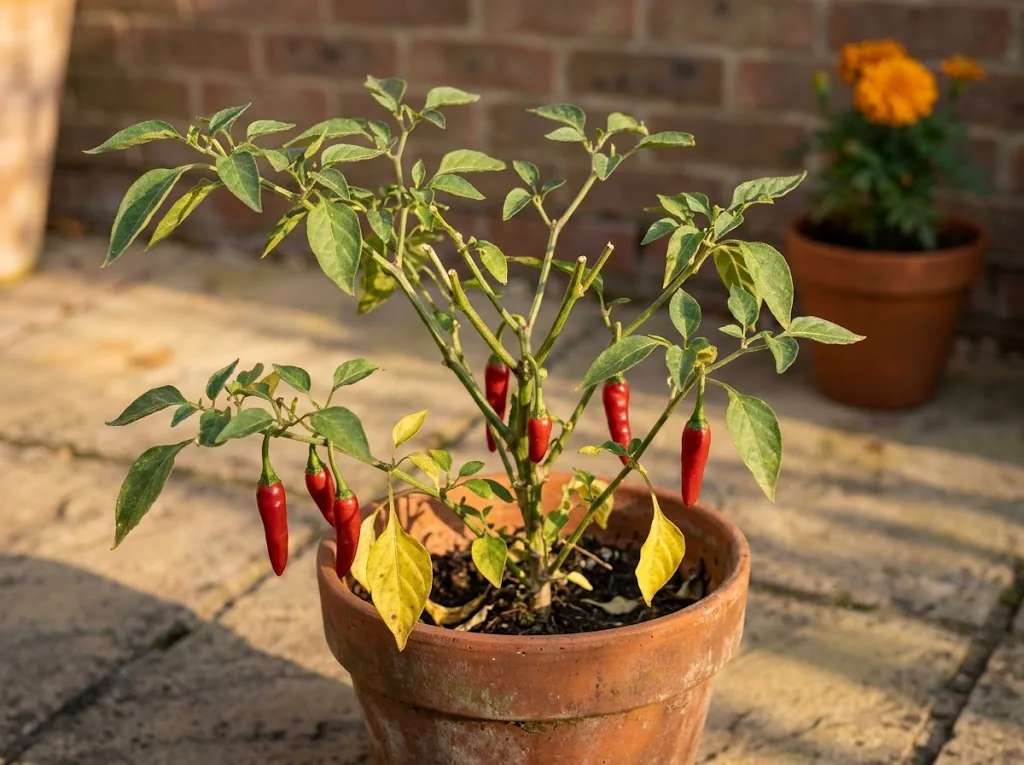
Common pruning mistakes to avoid
A few habits cause most of the failures beginners run into.
- Topping too early. Pinching a seedling with only two or three true leaves starves it of the foliage needed to recover. Wait until six to eight true leaves.
- Cutting below the cotyledons. The cotyledons are the first smooth, oval seed leaves. Cutting below them removes everything the seedling has built. Always cut above them.
- Heading every branch. The point of cutting is to shape, not to defoliate. A specimen with most of its branches tipped is in shock and will spend its energy regrowing leaves instead of flowers.
- Cutting during a heat wave or drought. A stressed bush cannot heal wounds. Wait for cooler weather and consistent moisture.
- Leaving stubs above the node. A stub longer than a centimeter dies back and invites rot into the stem. Cut close, leaving just enough to keep the node from drying.
A simple seasonal pruning calendar
- Seedling, four to six weeks: pinch out the top above the second set of true leaves.
- Early summer, before flowering: remove inward-facing and crossing branches.
- First flower cluster: pinch off on compact or slow varieties; leave it on tall vigorous ones.
- Midseason, only if needed: light shaping to keep the canopy open.
- Late summer, six weeks before expected first frost: stop cutting so the bush has time to set and ripen its final pods.
- Autumn, before frost: cut back by a third for overwintering, or remove the bush if it is being grown as an annual.
Frequently asked questions
Should you cut back in summer?
Only light shaping. Heavy cuts during hot, dry weather stress the bush and delay flowering. Save the bigger cuts for the cool end of the season.
Can you root the pieces you cut off?
Yes. Soft tip cuttings root easily in a glass of water or in a moist seed-starting mix under a humidity dome. Hardwood cuttings taken at the autumn cut back also root, though more slowly.
What if the plant is flowering and I have not topped it?
It is fine to leave an un-topped specimen to fruit. You will get fewer branches and a slightly smaller harvest, but the bush will still produce. Topping a flowering specimen sets it back more than topping a seedling, so for bushes in flower, leave the central leader alone and do light shaping only.
Do super-hot varieties need different pruning?
Yes, mostly in timing. Ghost, Carolina Reaper, and 7 Pot types develop slowly and benefit from an early pinch, but they should be cut only once and otherwise left alone. Heavy cutting on a super-hot delays flowering enough to push ripening past the end of the season in shorter climates.
The takeaway
Pruning is a small job with an outsized payoff when done at the right moment. Top the seedling once it has six true leaves. Pinch the first flower cluster on compact or slow varieties. Shape the canopy once midseason if it is crowded. Cut back by a third in autumn for any specimen you plan to overwinter. Skip the cuts on a bush that is already branching well, and skip the heavy cutting on baccatum or pubescens types. Treat each specimen on its own merits, and the snips will repay you with a sturdier bush, cleaner air through the canopy, and a heavier harvest from the same space.
For the broader framework on raising peppers from seed to a heavy harvest, the cluster guide on how to grow peppers lays out the rest of the season step by step.
