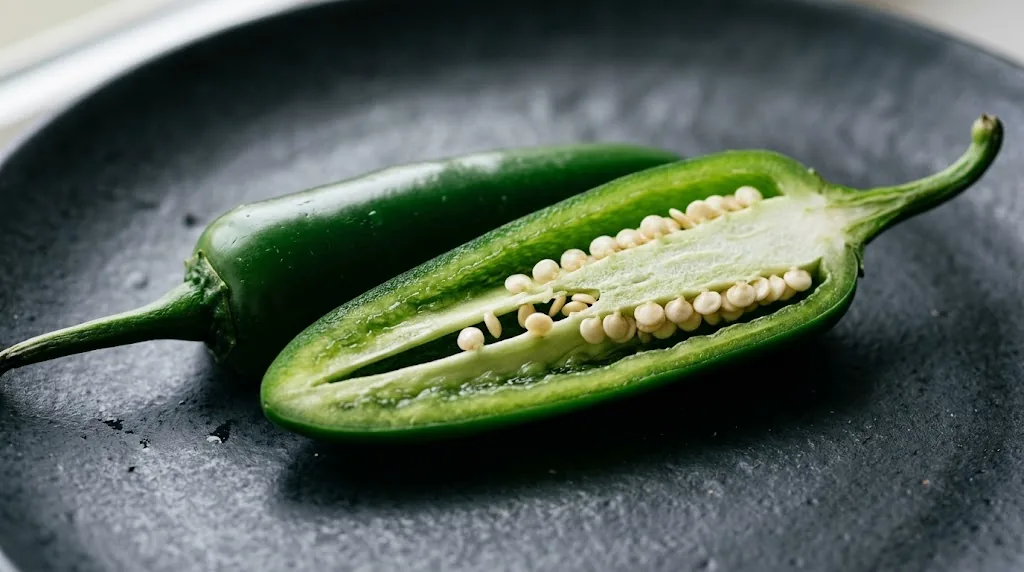
Most of a chili pepper’s heat is concentrated in the pale tissue inside the pod, especially the placenta where the seeds attach. The seeds can taste hot because capsaicinoids transfer onto their surfaces, but they are not the main source. If you want a milder bite, trim away the inner ribs and the seeds clinging to them.
Where a chili pepper’s heat is concentrated
The placenta is the soft inner tissue that connects the seeds to the fruit. In everyday kitchen language, people often call the pale ribs or pith. Capsaicinoids, the compounds behind pepper pungency, are made and accumulate most strongly in this tissue. In a study of Tabasco peppers, researchers found the placenta was richest in capsaicinoid-related compounds compared with the flesh and seeds. The exact distribution varies by cultivar and fruit, so think of the pale inner ribs as the usual hotspot, not a perfectly identical heat map in every pod. The Tabasco tissue study describes that difference, while our Scoville scale guide explains how pungency is compared across varieties.
The outer wall, or flesh, is not necessarily free of capsaicinoids. Researchers have measured these compounds in the flesh, placenta, and seeds of several Capsicum cultivars, with the amount varying across fruit and tissue. Removing the white tissue does not make a hot pepper completely mild, and two peppers from the same plant may not taste exactly alike. That is why a recipe’s chili pepper varieties or heat-level chart can only give you a starting point. Taste a small amount when it is safe and appropriate, then adjust the quantity to suit the dish. A comparison of different chili cultivars shows how this variation can appear between fruit and parts of the same pepper.
Placenta, pith, ribs, and seeds: the parts inside
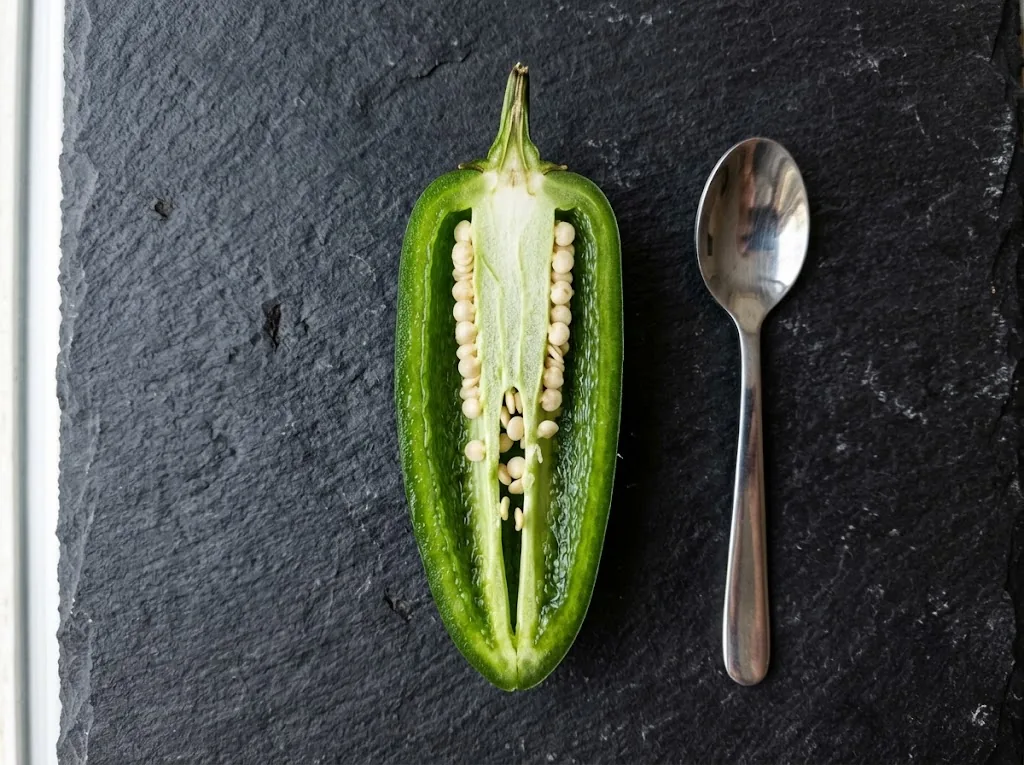
Cut a chili lengthwise and you can see the basic layout. The fleshy outer wall forms most of the pod. Inside, pale membranes run along the chambers and join at the central placenta, with seeds attached to that tissue. These parts touch, but they are not interchangeable: the seeds are reproductive structures, while the placenta and adjoining inner tissue are where much of the capsaicinoid activity is concentrated.
Kitchen terms are less precise than botanical ones. “Pith” and “ribs” usually mean the pale inner membranes a cook can scrape away. A cut pepper may leave some of the placenta behind even after its seeds have fallen out, which helps explain why seed removal alone does not always make a dish much less spicy. The location and amount of this tissue vary with the shape of the pepper, so there is no single neat patch to remove from every pod.
Are chili pepper seeds actually hot?
Seeds do not produce capsaicin. They sit against the placenta, though, and can pick up capsaicinoids from the surrounding tissue. That residue is why a seed may taste hot when you chew it. A Colorado State University jalapeño anatomy guide describes the same distinction: capsaicin glands sit near the placenta and inner wall, while seeds can absorb some capsaicin without making it themselves.
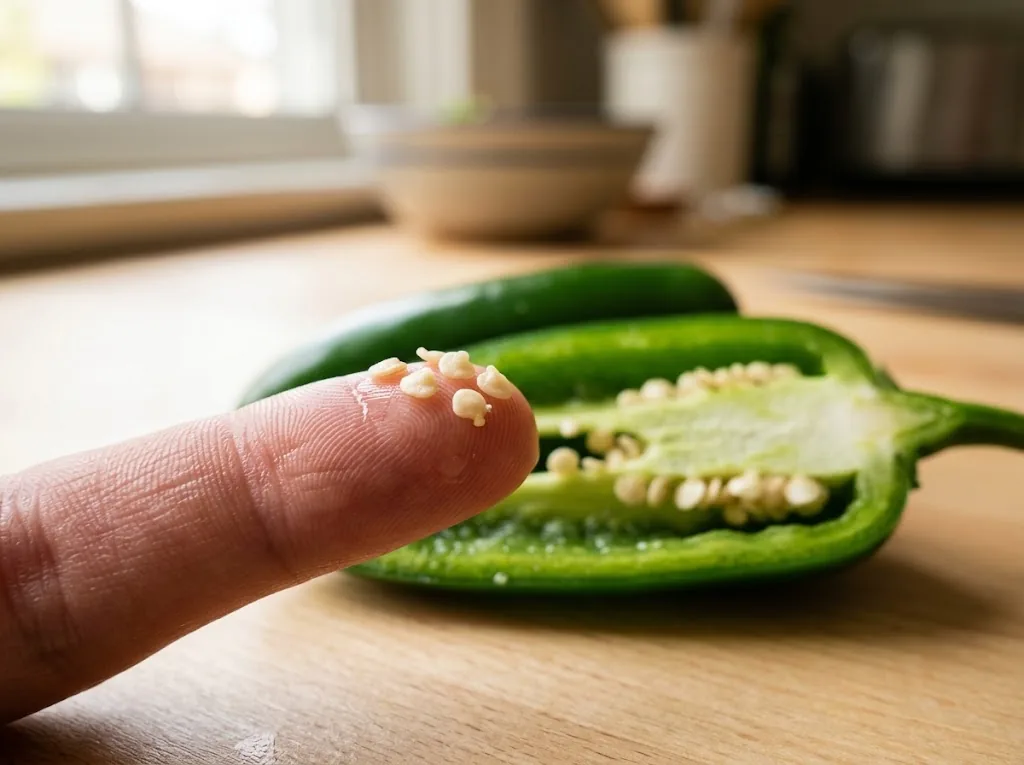
So the short answer to “are chili pepper seeds hot?” is: they can carry heat, but the seed itself is not the main heat-producing tissue. If you scoop out seeds but leave the ribs behind, much of the pepper’s strongest pungency can remain. If you remove the ribs and attached seeds together, you remove more of the usual hotspot.
What capsaicin does when you eat a chili
Capsaicin and related capsaicinoids create a burning sensation by activating heat-sensing receptors in the mouth. The feeling is a response to a chemical signal rather than a rise in the food’s temperature. For a closer explanation of the compound and how it interacts with those receptors, read what capsaicin is and how it works.
Not every chili has the same heat level. Variety, growing conditions, and the particular fruit all contribute to the amount of pungency. Bell peppers have no capsaicin, while hot chili peppers contain capsaicinoids that produce their characteristic burn. The Scoville scale gives a familiar shorthand for comparing that heat. The original method, introduced by American pharmacist Wilbur Scoville in 1912, used a dilution test: pepper extract was diluted until a tasting panel could no longer detect the burn. Its result was expressed in Scoville Heat Units (SHU). A rating is useful for comparing peppers, but it is not a promise that every pepper in a batch will taste the same.
Modern labs can measure capsaicin content more consistently with high-performance liquid chromatography (HPLC), which separates compounds in a sample so they can be identified and quantified. The National Institute of Standards and Technology describes how measured capsaicinoid levels can be converted to Scoville units. In the mouth, capsaicin binds to heat-sensing receptors and produces a burning sensation even though the food itself is not hotter. This is why a pepper’s heat rating tells you about its pungency, not the temperature of a dish.
How to make a chili pepper less spicy
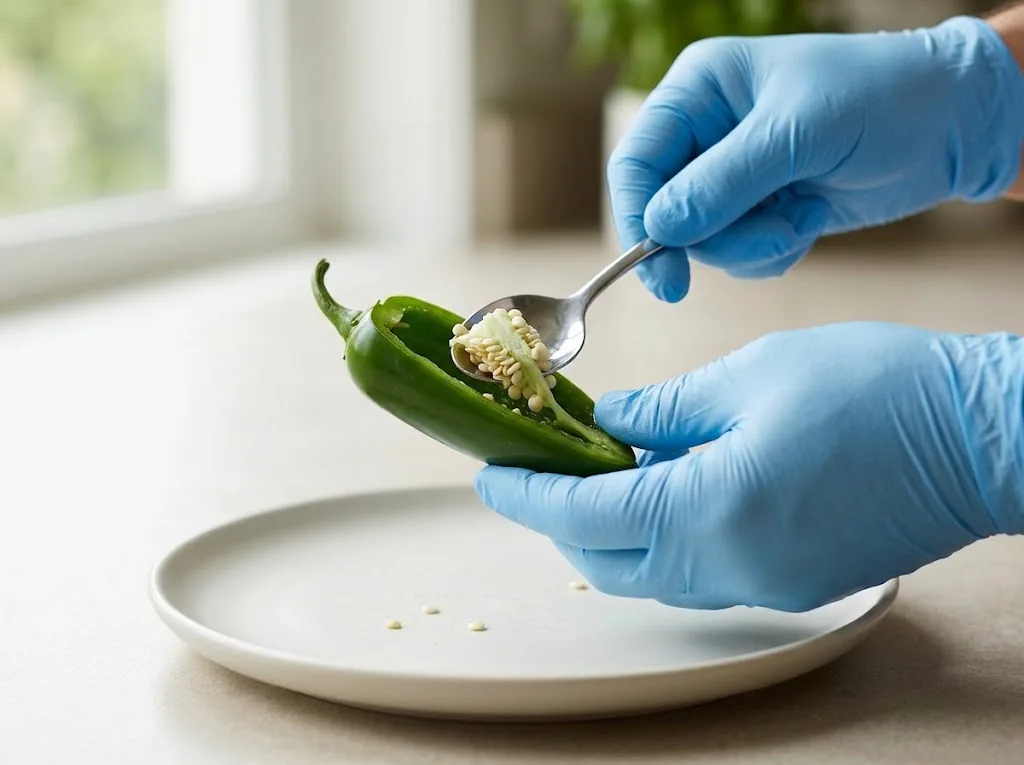
For a less spicy bite, cut the pepper lengthwise and scrape out the pale inner ribs and the seeds attached to them. Keep more of the flesh if you want pepper flavor with less of the concentrated heat. The amount you remove is a matter of taste, and it will not guarantee a specific result because peppers vary. If you are using the chili in a sauce or other spicy dish, start with a small amount and add more only after tasting.
Use a small spoon or the tip of a knife to loosen the membrane, and avoid rubbing your eyes while you work. Capsaicin can irritate skin and eyes. Wash your hands and utensils after cutting; disposable gloves can make handling hot chili peppers easier if you are sensitive to them. For a step-by-step kitchen walkthrough, see how to cut and seed chili peppers.
The quick answer
Most chili pepper heat is concentrated in the placenta and pale inner ribs, where capsaicinoids are produced and accumulate. Seeds may carry heat from contact with that tissue, but they are not the main source. Remove the ribs and attached seeds to reduce pungency, then adjust to taste.
Further reading and sources
- Tabasco pepper study of placenta, flesh, and seed metabolites, which found the placenta richest in capsaicinoid-related compounds.
- Study of capsaicinoid variation among chili cultivars and fruit tissues.
- Colorado State University’s jalapeño anatomy guide, for capsaicin location and seed contact.
- National Institute of Standards and Technology on measuring pepper heat, for receptors, Scoville units, and HPLC.
