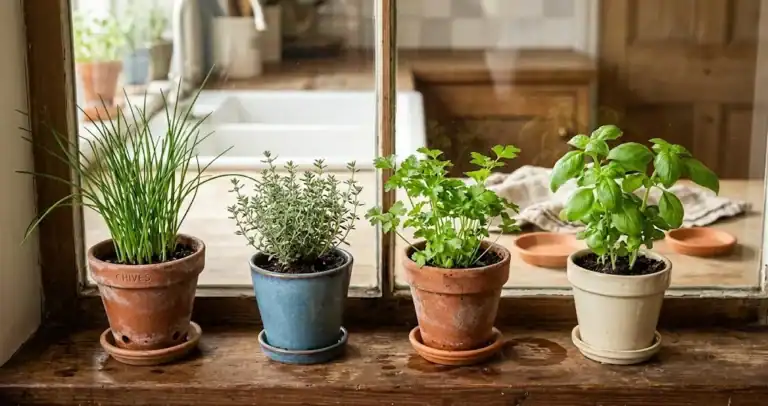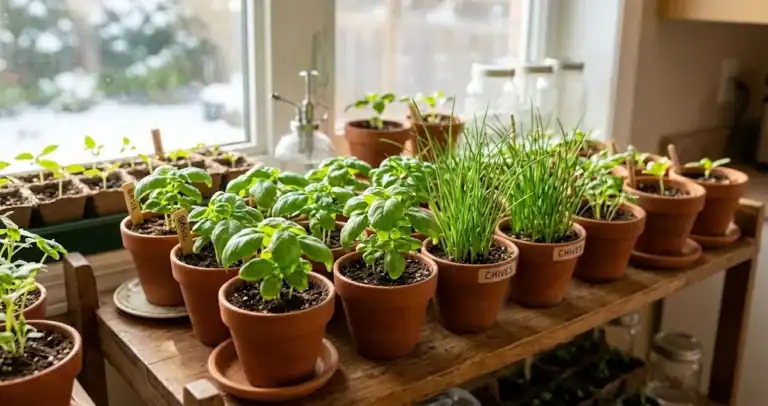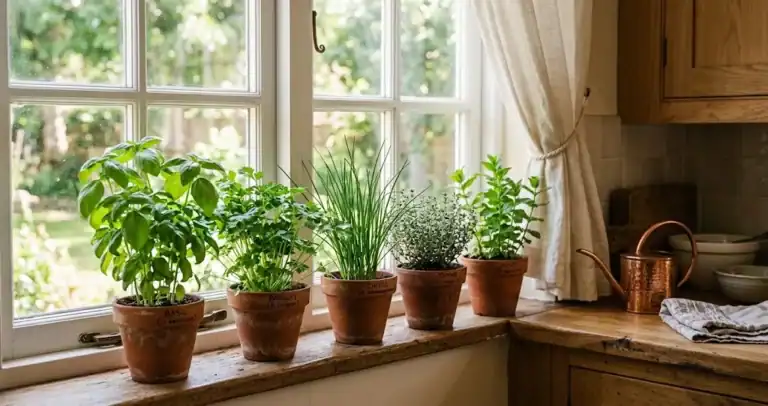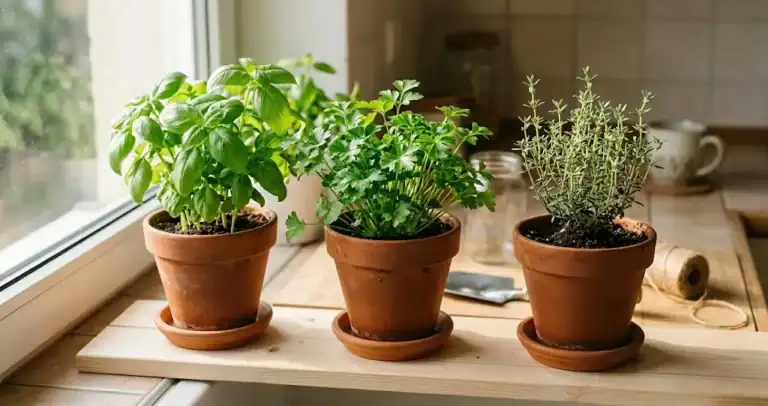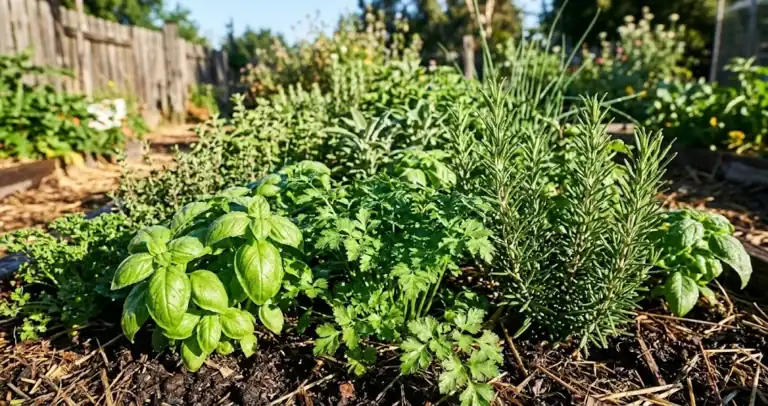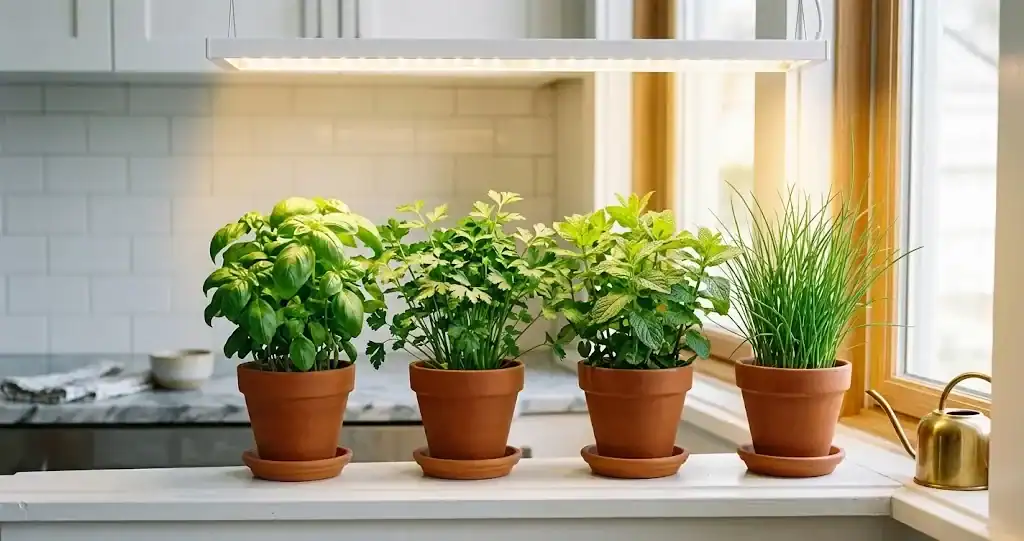
A sunny south-facing window is wonderful in summer, but most homes do not have enough natural light to keep an indoor herb garden productive through the winter or on a shaded sill. A grow light bridges that gap by giving basil, parsley, mint, and the rest of your potted kitchen herbs and houseplants the steady light they need whether you keep them on the countertop or in a small home garden to grow thick leaves and full flavor. This guide walks through what to look for in a grow light, where to put it, how long to run it, and how to keep your herbs from getting leggy, pale, or burned. If you are still working out the basics of an indoor setup, our primer on planning the indoor growing space covers light, water, and temperature together for an indoor garden.
Do indoor herbs actually need a grow light?
The short answer is yes, for most homes, and especially in winter. Culinary herbs come from sunny Mediterranean and temperate climates. Outdoors they get six to eight hours of natural light a day from the sun. A south-facing window in summer can match that, but the same window in December may give an herb less than a quarter of the light it needs to keep producing flavorful new growth.
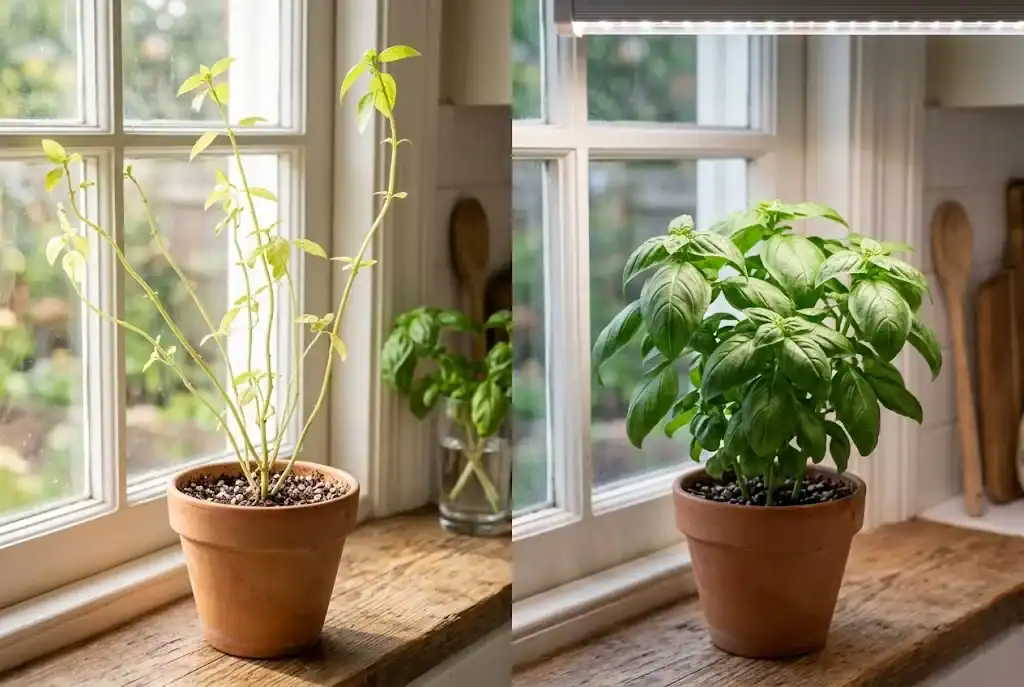
You can tell your herbs are short on light before they collapse. New stems stretch toward the window, leaves grow small and pale, and the spaces between leaves (the internodes) get longer. That leggy look is the plant reaching for more sun than the room is offering. A grow light solves the problem by adding the missing hours from above, where the plant naturally expects light to come from. Adding a full-spectrum led grow light above the canopy also speeds up plant growth overall compared with a low-light windowsill, and makes it easy to grow herbs indoors year-round even in a north-facing apartment, and it keeps an indoor plant producing steadily through the darker months of the year.
How grow lights differ from regular bulbs
A reading lamp or a kitchen ceiling light looks bright to your eyes, but plants use a different slice of the light spectrum. Photosynthesis runs on blue light and red light, with blue driving leafy growth and red supporting flowering and fruiting. A grow lamp built for herbs focuses most of its energy on those bands rather than spreading it across the whole visible spectrum the way a regular warm-white bulb does. A regular warm-white bulb leans toward yellow and emits relatively little of the blue light herbs benefit from for compact, flavorful foliage.
Grow lights are built to flood the blue and red bands that chlorophyll actually uses. Full-spectrum LED grow lights aim to cover the same wavelengths as natural light, which is why most home herb growers reach for full-spectrum panels rather than the older purple “blurple” panels. The newer full-spectrum bulbs also blend into a living room better than a magenta glow, give the leaves a more natural color than older fluorescent bulbs, and last long enough that the higher upfront cost pays back over years of daily cycles.
What to look for when choosing a fixture
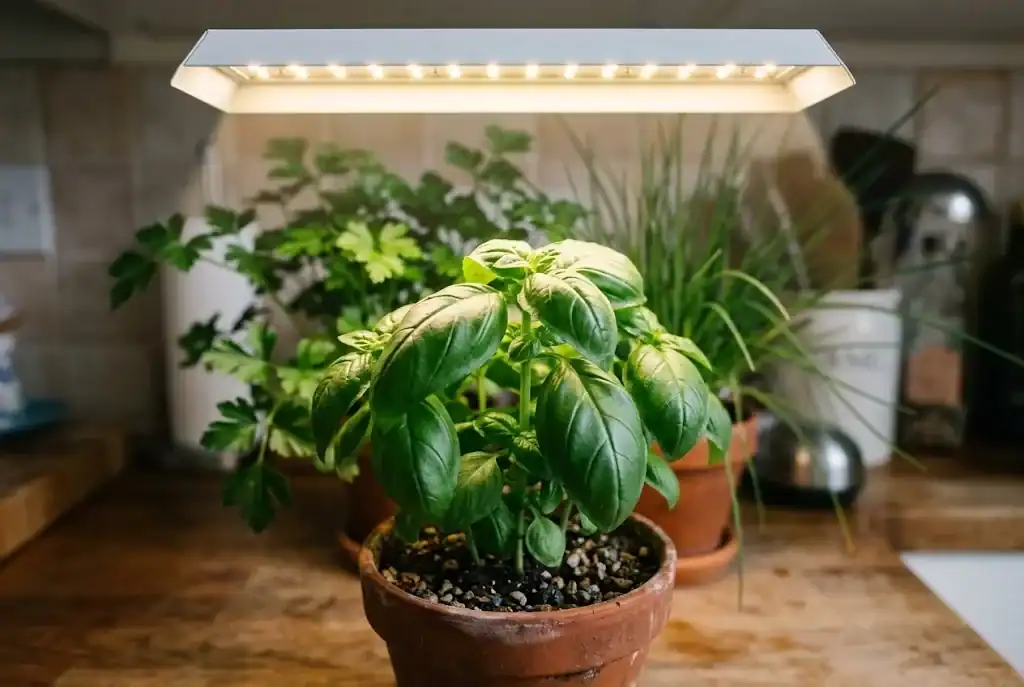
A grow light is not just a brighter bulb. The four numbers that matter most are spectrum, intensity, coverage, and adjustability.
Spectrum. Full-spectrum white LEDs rated for the PAR range (400 to 700 nanometers) work for nearly every culinary herb. The best led grow lights on the market today combine cool white, warm white, and a touch of red to cover the whole visible range that plants use. Red and blue diodes alone will grow herbs, but the purple light is harsh in a kitchen and the bulbs can feel clinical. Look for “full spectrum” or a listed Kelvin range of 4000K to 6500K if you want a light that doubles as a reading light.
Light intensity. Herbs need enough usable photons at the leaves to drive plant growth. The honest measurement is a photosynthetic photon flux density (PPFD) of around 200 to 400 micromoles per square meter per second during the light-on period. For a single shelf or a small tabletop herb garden, that translates into a light that draws 20 to 45 watts and is designed to hang 6 to 12 inches above the canopy. Wattage alone is not a fair comparison across bulb types, so check the manufacturer’s PPFD map when you can. For a kitchen counter setup, a 30 watt full-spectrum panel is a useful starting point. Tabletop grow lights and small clamp-on fixtures cover a single pot nicely, and a compact indoor setup with two panels under a 2-foot shelf is plenty for a serious home herb garden. For a multi-tier plant stand, two 100 watt panels cover the whole rack evenly.
Coverage. Match the light footprint to the footprint of your herbs. A 2-foot strip covers a windowsill row of three or four small containers, or one larger plant set on a saucer. A 4-foot panel covers a kitchen shelf or a 2 by 2 foot tray. Underbuying on coverage is the most common reason a corner of an herb garden fails while the middle thrives.
Adjustability. A light you can dim, raise, or lower on a built-in schedule gives you the most control as the seasons change. A model with adjustable height and a dimmable setting is worth a few extra dollars because it grows with your plants through the seedling stage into the leafy harvest stage, and it keeps the cycle steady without you having to remember it.
LED, fluorescent, or HID
LED is the default choice for a home herb garden. Modern LED lamps and LED grow lamps run cool, sip electricity, and last five years or more of daily use. A single LED light strip will outlast three or four generations of fluorescent tubes. They are also the easiest to find in a form factor that fits over a kitchen shelf or a windowsill row of pots. Most modern LED grow lamps use full-spectrum diodes that combine cool white, warm white, and a small amount of red to mimic outdoor sun; this is what gives the new generation of panel lights their reputation for steady, leafy growth.
Fluorescent tubes (T5 or T8) still grow good herbs and cost less up front, and they are a perfectly fine light fixture for a small indoor garden. They run a bit warmer than LEDs, need a reflector to focus the light downward, and the tubes lose intensity after a year or two of heavy use. If you already have a fluorescent shop light, it is a perfectly fine way to start, and a single T5 strip will keep a small basil or mint happy for months, though fluorescent bulbs gradually lose intensity and need replacing every year or two.
High-intensity discharge (HID) panels, including metal halide and high-pressure sodium, are overkill for a kitchen herb garden. They throw a lot of heat and pull a lot of power, and they are designed for the big yield of a flowering crop, not for basil on a counter.
Matching the spectrum to the herb
Not every herb wants the same light spectrum. The blue part of the spectrum (around 400 to 500 nanometers) drives compact, leafy growth, which is what basil, parsley, cilantro, chives, mint, and thyme want most. The red part (around 600 to 700 nanometers) pushes flowering and fruiting, which matters if you are growing something like a chili indoors but is mostly wasted energy on a leafy herb.
These LEDs blend blue light and red light with green and yellow wavelengths, which is why they look like clean white light to your eyes and still feed herbs the spectrum they actually use. If you want to be specific, look for a panel that lists a color temperature around 5000K for vegetative leafy growth, or one that combines 6500K white with a small amount of red 660 nanometer diodes. Both will give a leafy kitchen herb the spectrum it wants without forcing it toward flower.
If you are starting seeds indoors under the same light, the same spectrum works for both the seeding stage and the leafy harvest stage. A single full-spectrum panel will take a basil seedling from germination through to a productive adult without any change in the light setup.
How high should the light hang above the herbs
Distance matters more than most beginners expect. Begin by hanging a full-spectrum LED panel 6 to 12 inches above the top of the canopy, then watch the leaves over the first week. Bleaching or downward-curling leaves mean the panel is too close and should be raised, leggy stretched growth means it is too far and should be lowered, and pale patches on the tallest plants mean raise the light by another two inches. The next paragraph has a hand-warmth test as a secondary check.
A simple test: put your hand at leaf height, palm down, and hold it there for thirty seconds. If the back of your hand gets noticeably warm, the light is too close. A gentle warmth is fine.
Adjustable gooseneck or rail-mounted lights make this easier. So does a light with adjustable height and a dimmer, because you can keep the panel at a safe distance and turn the intensity down for very young seedlings coming out of a dome or humidity cover, then raise the panel and turn the intensity up through the growth stages as light plants mature into tall leafy herbs.
How long to run the light each day
Most culinary herbs do best with 14 to 16 hours of light per day, followed by 8 to 10 hours of dark. The dark matters: plants use the night to move sugars around and to set their growth rhythm. Running the light around the clock is not a shortcut to faster growth; it usually produces tired, pale plants.
A basic plug-in device that controls the on-and-off cycle is enough to keep things steady. Set it for the same window every day, ideally so the lights come on an hour or two before you wake up and switch off in the evening when you would normally be done cooking. Some growers split the cycle into morning and evening blocks, but a single block works just as well for culinary herbs. A built-in schedule with a built-in timer is the easiest way to control hours of use across the week without buying a separate device.
Grow light stands and mounting options
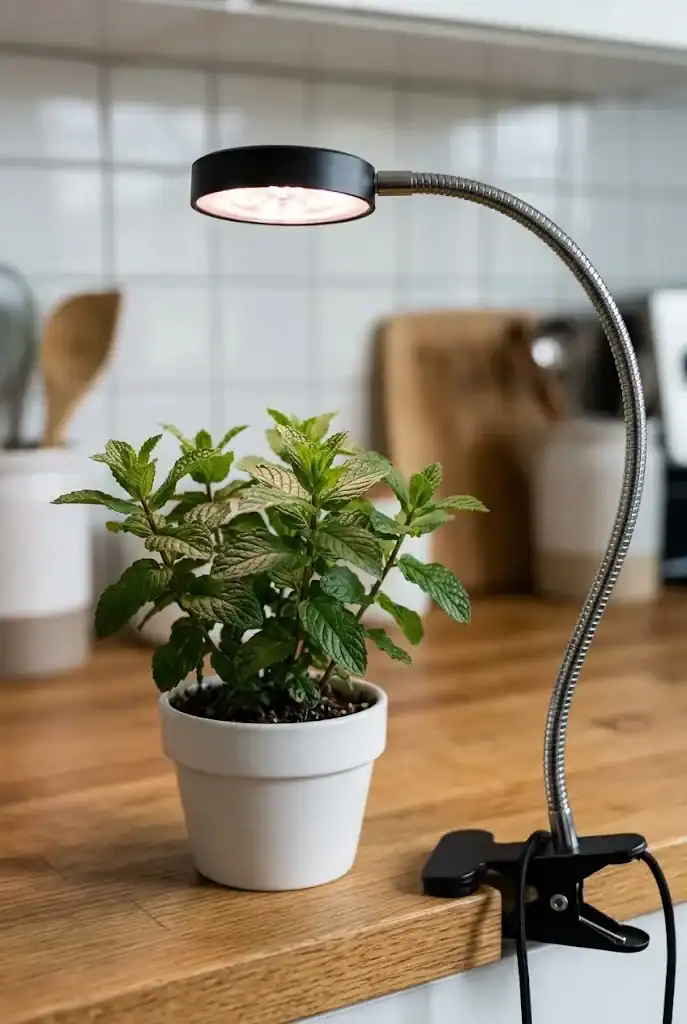
How you mount the light matters as much as which light you buy. The three most common setups are a clamp-on gooseneck for a single container, an under-shelf strip for a small herb shelf, and a multi-tier grow light stand for a serious indoor garden.
A clamp-on gooseneck bolts to the edge of a counter or shelf and lets you move the bulb from plant to plant. It is the cheapest option and works for one or two pots. An under-shelf strip hangs beneath a wire shelf, throwing light down onto the pots below it; two or three linkable strips give even coverage for a 3-foot kitchen shelf. A multi-tier grow light stand holds two to four shelves of pots under a single tier of panel lights and is what most dedicated indoor gardeners eventually buy.
Plant stands and rolling carts are useful when you want to move the herbs between a sunny window in summer and a darker corner in winter. Most indoor gardeners find they want one stand for leafy herbs and a smaller setup for taller plants like a bay tree, and a serious gardener with a dozen pots will eventually want two or three tiers. Look for a stand with adjustable height brackets so the light can ride up as the herbs grow into tall plants, and pick a stand with a tray underneath to catch the water that drains out of the pots.

Wattage, lifespan, and running cost
Most home herb growers end up with a 20 to 50 watt panel or a 10 watt strip, which is enough providing light for several leafy herbs at once without overloading a kitchen circuit. A 30 watt full-spectrum LED panel gives enough light for a 2 by 2 foot tray of leafy herbs, while a 10 watt strip is plenty for a single basil on a kitchen counter. A 100 watt panel is useful for a multi-tier stand or a wider herb shelf, but for most kitchens that is overkill.
How much a grow light costs to run comes down to three numbers: the panel’s wattage, the number of hours it runs each day, and your local electricity rate. The math is watts times daily hours, divided by 1,000, gives daily kWh; multiply that by your rate per kWh to get the daily cost. A 30 watt panel running 16 hours a day works out to 30 times 16 divided by 1,000, or 0.48 kWh per day, and the rest is a multiplication by your rate. An LED panel typically lasts 25,000 to 50,000 hours of use, which is ten years or more of daily cycles before you need to think about a replacement.
If you want a number to compare lights on, look for a published PAR or PPFD map rather than the wattage alone. Two 30 watt panels from different brands can have very different output depending on the diodes and the reflector design. If you want the leaves to look their natural color under the light, look for a CRI (color rendering index) of 90 or above, which most full-spectrum panels now exceed.
Best herbs to start with under a grow light
Leafy herbs and leafy greens both respond fastest to a steady grow light, and most other types of plants in a kitchen herb garden follow the same basic pattern of light and water. Basil, parsley, cilantro, chives, mint, and thyme all keep producing new leaves for months when they get steady light. Basil in particular stretches and loses flavor in low light, so a grow light turns a sad supermarket basil into a productive plant.
Woody Mediterranean herbs like rosemary, oregano, and sage can grow under the same light, but they grow slowly even in ideal conditions. Expect steady but modest harvests from these, and plan to replace the plant every couple of years as the stems get tough.
Sun-loving herbs such as basil, dill, and cilantro are the ones that struggle most in low light and benefit most from a grow light, while shade-tolerant herbs like parsley, mint, and chives tolerate a dim windowsill better than the sun-loving types.
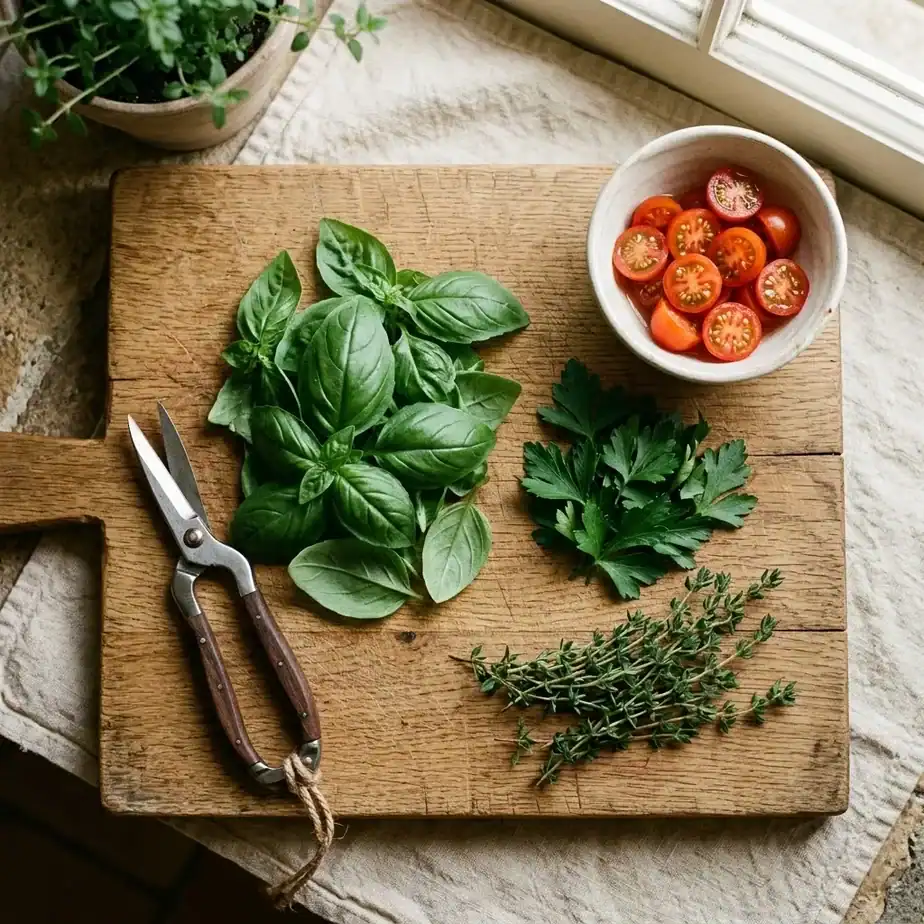
For a small kitchen garden, a mix of one or two leafy herbs and one woody Mediterranean herb gives you both quick wins and steady background flavor. If you would rather start herbs from seed rather than nursery starts, our walkthrough on seed starting under cover covers the lights, domes, and timing that give young seedlings a strong start.
Common problems and how to fix them
Leggy stems. The plant is reaching for more light. Move the light closer, raise the intensity, or add a second panel to widen coverage.
Pale leaves or yellow between the veins. Often a light issue, but check watering too. Soil that stays wet keeps the roots from pulling up nutrients, and the symptoms look similar to a light shortage. Let the top inch of soil dry between waterings and the yellowing should clear up if light is the real issue.
White or brown patches on the top leaves. Light burn. Raise the light or dim it by 20 to 30 percent. Trim the damaged leaves; the plant will replace them once it is back at a safe distance.
Flowers appearing on basil or cilantro. A signal of stress, often from a long uninterrupted light cycle or from the plant maturing. Pinch the buds off and the leaf production will continue for a few more weeks, which is how most growers hold the plant at optimal growth for an extra month before replacing it. Once a basil plant bolts it is past its prime; start a new one from seed or a cutting.
Quick setup checklist
Use this short list when you are ready to install a light over your herbs.
– Pick a full-spectrum LED panel or strip rated for vegetative growth.
– Match the light footprint to the size of your herb shelf or tray.
– Hang or mount the light 6 to 12 inches above the tallest plants, with adjustable height where you can.
– Set an on-off schedule for 14 to 16 hours on, 8 to 10 hours off.
– Check the leaves after a week. Pale, leggy growth means raise intensity or shorten the distance. Burned patches mean raise the light or dim it.
Once the light is dialed in, an indoor herb garden needs very little from you beyond steady watering and the occasional trim. Run the panel’s wattage times its daily hours divided by 1,000 to get the daily kWh, then multiply by your electricity rate to see the running cost. A good grow light is the closest thing to putting your herbs on a sunny Mediterranean windowsill, even in the middle of a Minnesota January.
Frequently asked questions
What type of grow light is best for herbs?
A full-spectrum white LED panel rated for the 4000K to 6500K range is the most versatile choice for a home herb garden. It delivers the blue and red wavelengths herbs use for leafy growth, runs cool, lasts for years, and the light color blends into a kitchen or living space. T5 fluorescent tubes are a solid lower-cost alternative if you already own a shop light. Most modern indoor herb gardens use full-spectrum panels rather than the older purple-only “blurple” lights.
Do herbs grow well under grow lights?
Yes. Most culinary herbs can grow well under a properly sized full-spectrum LED when conditions are suitable, including enough usable intensity at the canopy and a 14 to 16 hour daily cycle. Aim for 200 to 400 PPFD at the canopy for 14 to 16 hours a day. Basil, parsley, cilantro, chives, mint, and thyme all produce steady harvests under those conditions. A small setup with one or two panels will keep a kitchen supplied year-round.
Can regular LED lights be used as grow lights?
A regular warm-white LED bulb is better than nothing, but it is not a true grow light. Pick by the manufacturer’s stated plant-light output (usually given as photosynthetic photon flux density, or PPFD) at the canopy distance you plan to use, and confirm the coverage footprint reaches across the whole growing area rather than just the center. If you only have a desk light available, lean the herbs toward the brightest window you have and use the bulb as a daily top-up rather than the primary light source.
What are the drawbacks of using grow lights?
The main drawbacks are the upfront cost of a good panel, the small amount of electricity a daily cycle uses, and the need to set the light at the right distance and duration. None of these are large problems. To work out the running cost of a 30 to 45 watt panel on a 16 hour cycle, multiply the watts by the hours and divide by 1,000: 30 watts comes to 0.48 kWh per day and 45 watts to 0.72 kWh per day; then multiply by your local electricity rate. A basic on-off schedule keeps the cycle steady without any daily attention.
How much light do herbs need from a grow light?
Herbs use light in two ways: intensity (how strong the light is at the leaves) and duration (how many hours the light is on). Aim for 200 to 400 micromoles per square meter per second at the top of the canopy for 14 to 16 hours per day. Lower than that and the plants stretch. Higher than that and the leaves may bleach or curl.
How long should grow lights be on for herbs each day?
14 to 16 hours on, then 8 to 10 hours of full dark. Plants use the dark period to move sugars and to set their growth rhythm, so a consistent on-and-off cycle matters more than a longer light day.
How high should a grow light be above herbs?
For a full-spectrum LED panel, 6 to 12 inches above the top of the canopy is a good starting point. Watch the leaves for a week. Pale patches or downward-curling leaves mean the light is too close; new leggy growth means it is too far or too dim.
What are the best led grow lights for a kitchen herb garden?
For a small kitchen setup, look for a full-spectrum LED panel from a brand that publishes its PPFD map at the canopy distance you plan to use. The best led grow lights for herbs are usually a 30 to 45 watt panel with a dimmer and an adjustable height mount, which gives enough light for a 2 by 2 foot tray of leafy herbs without producing heat that would bother a houseplant sitting next to it.
What wattage panel do herbs need?
For a single windowsill pot, a 10 watt strip is enough. For a 2 by 2 foot tray of leafy herbs, a 30 watt panel is the usual choice. A multi-tier stand needs a 100 watt panel or two smaller ones to cover the whole shelf evenly. Wattage is a rough proxy for output: two panels at the same wattage can give very different light intensity depending on the diodes, so the published PPFD map is the more honest number.
Can I grow microgreens or hydroponic herbs under the same light?
Yes. Microgreens and hydroponic herbs want the same full-spectrum light as soil-grown herbs, with the same 14 to 16 hour cycle. A 20 to 30 watt panel over a shallow tray of microgreens produces a harvest in 7 to 14 days, and a hydroponic setup with a single LED grow lamp over a small reservoir will keep a steady supply of lettuce, basil, and mint going year-round.
How long do LED grow lights last?
Most LED grow lights carry a manufacturer rating of 25,000 to 50,000 hours of use, which is a useful durability benchmark but not a guarantee. The actual lifetime cost depends on the panel’s wattage, daily hours, electricity rate, purchase price, and how much the output drops over the years, so it varies widely by model and by home. The diodes dim very slowly over that lifespan rather than burning out the way older incandescent bulbs do, so the panel still works at the end but may give 80 to 90 percent of its original output. For a daily running cost, multiply the panel’s wattage by its daily hours and divide by 1,000 to get kWh, then multiply by your local rate.
What factors should be considered when choosing a panel for herbs?
Spectrum (full spectrum is best), intensity (200 to 400 PPFD at the canopy), coverage (match the footprint to your herb shelf), and adjustability (a dimmer and a built-in on-off schedule make day-to-day care much easier). Also consider how the light looks in your kitchen; a white LED panel is easier to live with than the older purple “blurple” lights.
What are the benefits of using LED grow lights for herbs?
LED panels pack a useful amount of light into a small unit, last five years or more of daily use, and the newest full-spectrum models put out light that reads as warm white to your eyes, so the panel looks normal in a living space. When setting the height, follow the panel’s own guidance and adjust based on how the leaves respond: bleaching or downward curl means the panel is too close and should be raised, leggy stretched growth means it is too far and should be lowered. Efficiency varies by brand and diode, so compare the published PPFD map at your canopy distance rather than relying on a category generalization.
Can different herb varieties be grown under the same grow light?
Yes. Basil, parsley, cilantro, chives, mint, thyme, oregano, and rosemary all share the same basic light needs, so a single full-spectrum panel can cover a mixed kitchen shelf. Group plants with similar water needs under the same light to make watering simpler, and remember that woody herbs like rosemary and thyme grow more slowly even under ideal conditions.
A useful next step
Once your herbs are getting steady light, the next decision is where to put them. A windowsill setup, a freestanding shelf, and a tabletop herb kit each have different tradeoffs for light coverage and watering. For a broader look at garden planning beyond the kitchen shelf, our beginner’s guide to growing an herb garden brings the same principles outdoors and covers the soil, sun, and spacing that turn a kitchen shelf into a backyard bed.
Bringing it together
A grow light is the simplest single upgrade you can make for an indoor herb garden, and the right panel takes over the work of providing light for every leafy herb in your kitchen. Pick a full-spectrum LED, set it 6 to 12 inches above the canopy, run it 14 to 16 hours a day on a built-in schedule, and water when the top inch of soil dries out. Within a few weeks your herbs will grow thicker, greener, and far more productive than a windowsill alone could manage, and you will have fresh flavor steps from the stove all year.